By Nikhil Kumar. Last updated August 2026.
Search “best social media API” and you get ten lists that do not agree, because they are answering different questions. Some rank tools that post; some rank tools that read; almost none tell you which one you actually need.
The best social media API in 2026 depends on one question: do you want to post, or to read? Posting APIs like Buffer publish to accounts you own. Data APIs like ScraperSocial read public content you do not own. Analytics APIs like Phyllo pull audience demographics. They are three different products, and picking the wrong category is the most common and most expensive mistake. This guide sorts the field by job, with honest prices.
What are the three kinds of social media API?
Post, read, and analyze, plus the native platform APIs underneath. Posting APIs publish and schedule content to accounts you control. Data APIs read public content, like transcripts, comments, profiles, and search across platforms you do not own. Analytics APIs pull audience demographics and earnings for creators. The official platform APIs sit under all three, but they only serve your own authenticated account.
Name your branch first and most of the field falls away before you read a single price.
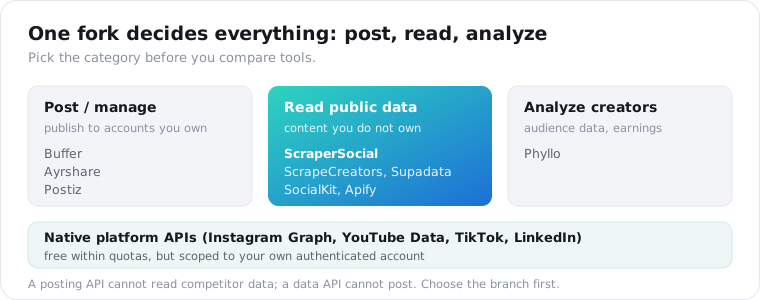
The trap is that most people type “social media API” meaning one of these and land on a list built for another. A posting API will never return a competitor’s comments; a data API will never publish your post.
So before comparing anything, answer the fork. The rest of this guide is one section per branch.
Best social media APIs for posting and scheduling
If you want to publish across platforms, these lead. Posting APIs authenticate as the accounts you own and push content out, usually with scheduling, analytics on your own posts, and increasingly an MCP server for AI agents. Buffer’s own roundup is a good map of this category, and Buffer is the strongest free entry.
- Buffer. Free tier with one API key, an MCP server, a CLI, and 11 channels. Best free starting point for posting.
- Ayrshare. $149/mo Premium (13+ platforms) with comment management and messaging. Best for teams that need the full posting-plus-inbox stack.
- Postiz. Open-source and free self-hosted, cloud from $29/mo, 30+ platforms including decentralized networks. Best open-source option.
- Upload-Post. Free for 10 uploads a month, paid from $16/mo, ships an MCP server. Best cheap agent-ready poster.
- Zernio. From $19/mo across 15 platforms, with ads and an MCP server. Best if paid campaigns are in scope.
- Post for Me. $10/mo for 1,000 posts, per-post pricing, unlimited accounts. Best pay-per-post model.
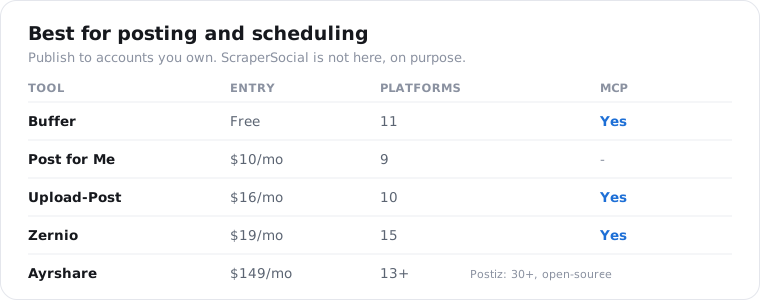
ScraperSocial is not on this list, and that is on purpose. We read public data; we do not post. If publishing is your job, one of the six above is the right tool.
Best social media APIs for reading public data
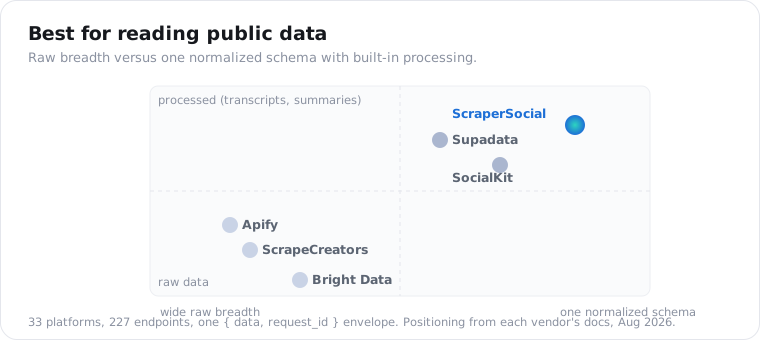
If you want to read public content at scale, this is the category, and where ScraperSocial sits. Data APIs pull transcripts, comments, profiles, stats, and search from public pages across platforms you do not own, returned as structured JSON. This is the tooling behind competitor research, social listening, and feeding AI models.
- ScraperSocial. One normalized API across 33 platforms and 227 endpoints, with transcripts, AI summaries, comments, and search in a single
{ data, request_id }envelope, from $5/mo. Best when you want breadth plus one schema plus built-in processing. - ScrapeCreators. The widest raw platform list (20+ platforms, 36+ APIs) including ad libraries, pay-as-you-go from $10, credits never expire. Best for raw breadth.
- SocialKit. Deepest YouTube coverage plus AI summaries on every platform, from $29/mo. Best when YouTube is central.
- Supadata. Transcript-first with an AI fallback for caption-less video and web crawling, from $5/mo. Best for transcription pipelines.
- Apify. A marketplace of 24,000+ scraper actors for any site, from $29/mo plus compute. Best for custom or non-social scraping.
- Bright Data. Enterprise proxy infrastructure with dataset delivery around $1.50 to $2.50 per 1,000 records. Best for bulk at scale.
For the platform-specific deep dives, we have separate guides on the best Instagram data APIs, the best social search APIs, and the best LinkedIn scraping APIs. This section is the map; those are the detail.
The data category runs deeper than these six. Infrastructure and dataset vendors like EnsembleData, Zyte, ScrapingBee, and Data365 also sell public social data, and each “best social media scraping API” roundup ranks a slightly different set. The six above are the ones most teams actually shortlist for social specifically.
There is also a narrower analytics branch: Phyllo pulls creator audience demographics and earnings across 20+ platforms on custom pricing. If your job is influencer vetting rather than raw content, that is its own tool.
What about the official platform APIs?
Free within quotas, but scoped to your own account. Instagram Graph, YouTube Data, TikTok, and LinkedIn all publish APIs, and per Phyllo’s developer guide most are free up to a daily quota, such as YouTube’s 10,000 units a day. The catch is access: they read the authenticating account, not arbitrary public profiles, and LinkedIn has no public pricing at all.
They have also tightened. Reddit began pricing commercial API access at $0.24 per 1,000 calls in 2023, X’s official API starts at $200 a month, and each restriction pushed more teams toward third-party data APIs. Our own Reddit API pricing breakdown walks through one example in detail.
That is the gap the whole third-party market fills.
If you only need your own account’s data, start with the native API; it is free and official. The moment you need data from accounts you do not own, you are in data-API territory.
How do you choose a social media API?
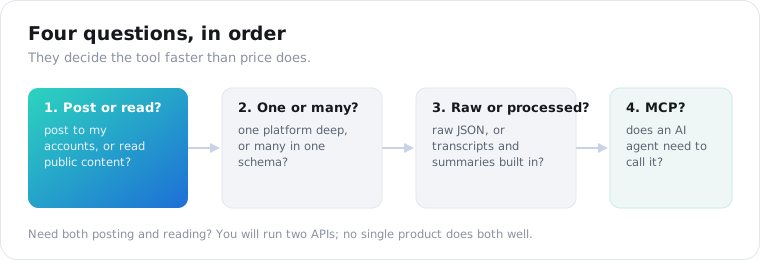
Answer four questions in order. First, post or read. Second, one platform or many. Third, do you want raw data or processed outputs like transcripts and summaries. Fourth, does your stack need MCP for AI agents. Those four narrow ten lists down to one tool, and they matter more than the sticker price.
One question the other lists skip: how the tool collects. Reading public pages logged out is lower-risk than automating a logged-in account, and after the Proxycurl shutdown it is the line that separates a durable data API from one that gets sued. If you are handling personal data, weigh collection method and retention alongside price.
Two more honest notes. If you need both posting and reading, you will run two APIs, because no single product does both well. And if you are optimizing for raw bulk price at massive scale, the infrastructure players undercut the specialists, at the cost of doing the normalization yourself.
MCP is the tiebreaker to watch in 2026. On posting, Buffer, Upload-Post, and Zernio ship it; on data, ScraperSocial pairs MCP with OpenAPI, llms.txt, and .well-known discovery so an agent can call it with no human setup.
How much do social media APIs cost?
From free to enterprise, and the model matters more than the number. Posting APIs run free to about $150/month for a team stack. Data APIs run $5 to $29/month at entry and bill per item or per record after that. Enterprise infrastructure and analytics tools go to custom quotes. Compare the meter, not the sticker.
| Tool | Category | Entry | Notes |
|---|---|---|---|
| Buffer | Posting | Free (1 key) | MCP, 11 channels |
| Ayrshare | Posting | $149/mo | 13+ platforms, inbox |
| Postiz | Posting | Free self-hosted | 30+ platforms, open-source |
| ScraperSocial | Data | $5/mo (1,000 credits) | 33 platforms, per item, MCP + OpenAPI |
| Supadata | Data | $5/mo (300, annual) | transcripts + web crawl |
| ScrapeCreators | Data | $10 (pay-as-you-go) | 20+ platforms, raw |
| SocialKit | Data | $29/mo | deepest YouTube |
| Apify | Data (infra) | $29/mo + compute | 24,000+ actors |
| Phyllo | Analytics | Custom | creator audience data |
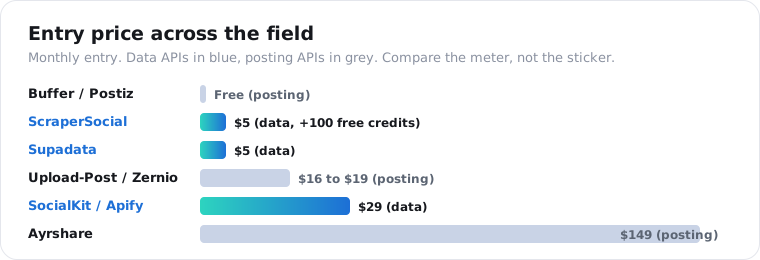
ScraperSocial is the lowest paid entry in the data category at $5/mo, with 100 free credits and no card to start. Full numbers are on the pricing page.
The short version
The best social media API is the one built for your job, not the top of someone’s list. Want to post? Buffer, Ayrshare, or Postiz. Want to read public data across platforms? ScraperSocial for one schema and built-in processing, ScrapeCreators for raw breadth, Supadata for transcripts, SocialKit for YouTube. Want creator analytics? Phyllo. Answer post-or-read first, then one-or-many platforms, then raw-or-processed, and the shortlist is obvious.
Frequently asked questions
What is the best social media API in 2026?
There is no single best one, because social media APIs do three different jobs. For posting and scheduling across platforms, Buffer or Ayrshare. For reading public data like transcripts, comments, and profiles, ScraperSocial or ScrapeCreators. For creator audience analytics, Phyllo. Decide whether you want to post, to read public data, or to pull audience demographics before you compare tools, because a posting API cannot read competitor data and a data API cannot post.
What is the difference between a posting API and a data API?
A posting API publishes content to accounts you control, like Buffer scheduling to your own pages. A data API reads public content you do not own, like pulling the comments on any public video. They are different products: posting APIs authenticate as your accounts and cannot see competitor data; data APIs read public pages and cannot post. Most “social media API” searches want posting; competitor research and analysis want a data API.
Is there a free social media API?
Yes, several. Buffer offers a free posting API tier with one key, YouTube’s Data API gives 10,000 free units a day, and Postiz is free self-hosted. For reading public data, ScraperSocial includes 100 free credits with no card, and Supadata gives 100 credits a month. Free tiers are enough to test; production posting or data pulls move you to a paid plan quickly.
What is the best social media API for reading public data?
For one normalized API across the most platforms with transcripts, comments, profiles, and search built in, ScraperSocial covers 33 platforms and 227 endpoints from $5 a month. ScrapeCreators has the widest raw platform list, Supadata leads on transcripts, and SocialKit is strongest on YouTube. Pick by whether you value one schema, raw breadth, or a single deep platform.
Do the official platform APIs work for social media data?
Only for your own account or narrow approved cases. Instagram Graph, YouTube Data, TikTok, and LinkedIn APIs are free-ish within quotas but read the authenticating account, not arbitrary public profiles, and LinkedIn has no public pricing at all. To read public data across accounts you do not own, a third-party data API is the practical route, which is why the whole data-API category exists.
Which social media APIs support MCP for AI agents?
MCP is the fastest-growing feature in 2026. On the posting side, Buffer, Upload-Post, Zernio, and Genviral ship MCP servers. On the data side, ScraperSocial, SocialKit, Supadata, and ScrapeCreators expose MCP, and ScraperSocial adds OpenAPI, llms.txt, and .well-known discovery so an agent can find and call it with no human setup.
Start with the job, not the list
Decide post or read first, then pick from the right category above. If your job is reading public social data across platforms, the full alternatives comparison has the head-to-heads, a TikTok transcript call shows the response shape, the quickstart issues a key in a minute, and 100 free credits are enough to pull a real platform end to end before you commit.