By Nikhil Kumar. Last updated August 2026.
Most “best social search API” lists are secretly ranking something else. They list monitoring dashboards, not search APIs.
The best social search API in 2026 depends on the job. For the widest coverage in one call, SocialCrawl leads. For a clean pay-per-result API across a dozen social networks with AI-agent support, ScraperSocial fits. For enterprise creator-economy work, Phyllo. There is no universal winner, because “social search API” means three different products that get lumped together.
This is a comparison post, so I will say where each tool loses, including ours. If you want the short version: figure out which of the three products you actually need first.
What is a social search API?
A social search API takes a keyword or hashtag and returns matching public posts from social platforms as JSON, without you owning the accounts. That is different from a platform’s official API, which mostly serves data for accounts you manage, and different from a scraper aimed at one profile. The best social search APIs answer one query across many platforms in a single request shape.
The phrase gets used for three separate things. First, a single platform’s own search endpoint, like Reddit’s search or X’s recent-search. Second, a unified cross-platform search API that fans one keyword out to many networks. Third, a social listening tool that happens to expose an API.
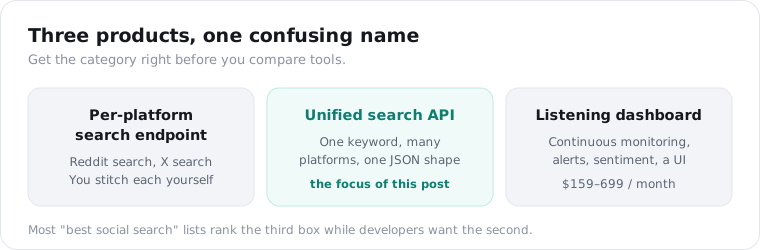
Get the category right and the shortlist writes itself. Get it wrong and you buy a $199-a-month marketing dashboard when you wanted a $10 developer API, or the reverse.
Social search vs social listening: what’s the difference?
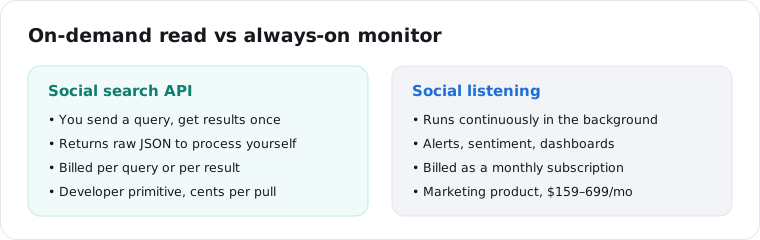
A social search API is on-demand and a social listening tool is continuous. With search, you send a query and get results back once, like a database read. With listening, you set keywords and a service monitors platforms around the clock, alerting you on new mentions with sentiment scores and a dashboard. Search is a developer primitive; listening is a marketing product built on top of one.
The difference matters for price and audience. Listening tools like Brand24, Talkwalker, and Octolens run $159 to $699 a month because you pay for monitoring, storage, sentiment, and a UI.
A search API charges per query or per result, so a one-off research pull costs cents, not a subscription. If you want alerts and charts, buy listening. If you want raw matching posts to process yourself, buy search.
This post is about search APIs. I will flag the listening tools where they overlap, but they are a different purchase.
Why not just use each platform’s own search API?
Because you end up maintaining one integration per platform, each with its own auth, rate limits, and pricing, and several of them are now hostile. The official X API removed its free read tier and bills per post read. Reddit caps any search at about 1,000 results. Instagram’s official API exposes almost no public content search at all. Stitching five of these together is five separate problems, not one.
The X situation is the sharpest. As of 2026, the X API has no real free tier and defaults to pay-per-use, at roughly $0.005 per post read, with the old $200-a-month Basic plan retired and its users force-migrated. Search is capped at 450 requests per 15 minutes.
Reddit is friendlier but limited. Its API is free within 100 queries per minute, yet any single search stops at about 1,000 results, so deep queries need time-slicing.
Instagram barely lets you search public content through official channels, which is why the third-party market exists at all. Each platform is its own shape, its own token, its own failure mode.
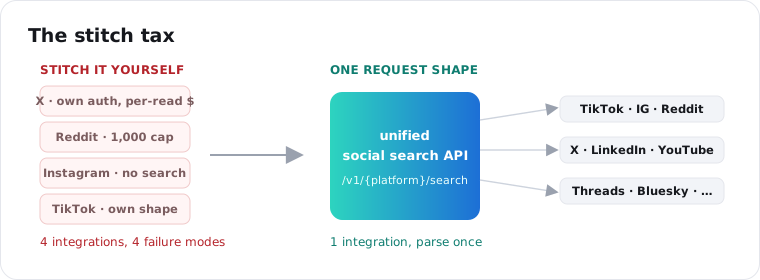
That maintenance tax is the whole reason to buy a unified social search API instead of building one.
What are the best social search APIs in 2026?
For developers who want to search social platforms by keyword and get JSON back, five providers matter: SocialCrawl and ScraperSocial for unified cross-platform search, Phyllo for enterprise integrations, and Apify or Bright Data for per-platform scraping with search. Social listening tools like Brand24 sit next to these but solve monitoring, not search. Here is the honest rundown.
SocialCrawl, the widest coverage
SocialCrawl is the coverage leader. It advertises 40-plus platforms through one API key with a fully unified schema, so followers and engagement_rate mean the same thing whether the row came from TikTok, Instagram, or YouTube. Pricing is pay-per-credit, roughly a few dollars per couple thousand credits, with 100 free to start.
If your job needs the longest tail of networks in one integration, this is the strongest option here. The trade-off is that broad coverage means you verify each platform’s field depth yourself, because not every network returns the same richness.
ScraperSocial, pay-per-result across a dozen platforms
ScraperSocial searches roughly a dozen social and community platforms from one request shape: TikTok, Instagram, Reddit, X, LinkedIn, YouTube, Threads, Bluesky, Pinterest, Rumble, and more, plus web and news. Every search endpoint takes the same query parameters and returns the same envelope, and most results cost 1 to 2 credits at $0.005 each, so a result is about a cent. It is MCP-native, so an AI agent calls it as a tool.
It does not cover as many networks as SocialCrawl, and I will not pretend otherwise. Reach for it when your platform set is the mainstream dozen, you want per-result billing, or you are wiring search into an agent.
Phyllo, built for enterprise integrations
Phyllo is a unified social data API aimed at the creator economy and enterprise buyers. It connects to many platforms through one API and can surface keyword mentions across posts, bios, comments, and hashtags. Pricing is not public; you talk to sales.
That enterprise posture makes it a fit for funded teams building creator-facing products who want a contract and support, and a poor fit for a solo developer who wants to swipe a card and start. Best when procurement is involved.
Apify, per-platform search actors
Apify is a marketplace of prebuilt scrapers, including search actors for individual platforms. There is no single cross-platform search call; you pick a TikTok search actor, an Instagram hashtag actor, and so on, each priced per result at around $1.50 to $2.70 per 1,000. You pay a platform subscription plus per-actor fees.
It fits teams that already run Apify or need custom, non-social scraping alongside search. As a unified social search layer it is the wrong shape, because you assemble and maintain the fan-out yourself.
Bright Data, enterprise scale per platform
Bright Data sells per-platform scraper APIs with search parameters, backed by a huge residential proxy network, at roughly $0.75 to $1.50 per 1,000 records. Like Apify, it is per-platform rather than one unified search endpoint.
It earns its place when you need scale, heavily blocked targets, or historical datasets, and it is heavier than most projects need for a keyword search across a few networks.
Brand24 and Octolens, if you actually want listening
These are not search APIs, but people land on them searching for one. Brand24, Octolens, and Talkwalker are social listening platforms at $159 to $699 a month that monitor keywords continuously, score sentiment, and expose an API mostly on higher tiers.
Buy them when you want ongoing brand monitoring with alerts and charts, not a raw query you run from code. For on-demand search that you process yourself, they are expensive overkill.
How do you search many platforms with one API?
You send the same request shape to each platform’s search path and read back the same envelope. With a unified social search API, /v1/reddit/search, /v1/tiktok/search, and /v1/youtube/search all take a query parameter and return the same { data, meta, request_id } object. Adding a platform is a one-line change, not a new integration, which is the entire reason to buy unified instead of stitching.
In practice, searching three networks for the same keyword is a loop:
import requests
PLATFORMS = ["reddit", "tiktok", "youtube", "bluesky"]headers = {"Authorization": "Bearer sk_live_..."}
for platform in PLATFORMS:    r = requests.get(        f"https://api.scrapersocial.com/v1/{platform}/search",        params={"query": "your keyword", "limit": 50},        headers=headers,    )    for post in r.json()["data"]:        print(platform, post["url"])
Every platform answers on the same shape, so your parsing code is written once. The differences that remain are per-platform realities, like Reddit’s roughly 1,000-result cap, not differences in how you call the API. That is the practical payoff of a social search API over a rack of official endpoints.
How much does a social search API cost?
Search APIs bill per query or per result and run from about a cent per result up, while listening tools bill a monthly subscription from $159 up. A pay-per-result API like ScraperSocial charges roughly a cent per matching post; SocialCrawl bills per credit at a similar order; Apify and Bright Data charge per 1,000 results; and official platform APIs like X now meter per read. Monitoring dashboards are a different pricing universe entirely.
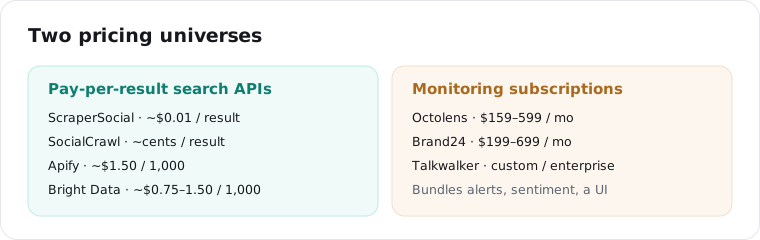
The honest read: if your monthly volume is bounded and bursty, a pay-per-result API is far cheaper than any subscription. If you monitor the same keywords forever, a subscription can win, but then you probably want a listening tool, not a search API.
Here is the field in one table.
| Provider | Platforms | Model | Price | Best for |
|---|---|---|---|---|
| SocialCrawl | 40-plus | Pay-per-credit | ~cents/result | Widest coverage |
| ScraperSocial | ~a dozen social | Pay-per-result | ~$0.01/result | One shape, AI agents |
| Phyllo | Many | Contract | Sales-quoted | Enterprise integrations |
| Apify | Per-platform | Sub + per-result | ~$1.50/1k | Existing Apify users |
| Bright Data | Per-platform | Pay-per-success | ~$0.75–1.50/1k | Scale, blocked targets |
| Brand24 / Octolens | 10-plus | Subscription | $159–699/mo | Monitoring, not search |
Which social search API covers the most platforms?
SocialCrawl covers the most, advertising 40-plus platforms in one unified API, more than any developer-facing search API here. ScraperSocial searches roughly a dozen social networks plus web and news, Bright Data and Apify work per platform, and the listening tools cover 10-plus for monitoring. If raw network count is your single deciding factor, SocialCrawl wins it outright.
Coverage count is not the whole story, though. A dozen well-supported platforms with consistent fields can beat 40 where half return thin data.
Check that your specific platforms are covered deeply, not just listed. A network that appears in a coverage table but returns three fields is not really covered for search.
Is it legal to search and store social media data?
Searching public social posts is generally treated as legal in the US, but storing and reusing them carries terms-of-service and privacy duties. The hiQ v. LinkedIn litigation established that scraping publicly accessible data does not by itself break the Computer Fraud and Abuse Act. Every platform’s terms still restrict automated access, though, and personal data falls under GDPR and CCPA. A search API does not launder those duties; it only handles the fetching.
Keep it to public data. Store the fields you need, honor deletion requests, and avoid pulling personal information you cannot justify.
The practical upside of a managed search API is that it absorbs the anti-bot arms race, rotating infrastructure so your query returns results instead of blocks. This is general information, not legal advice, so check your own case with a lawyer.
Which social search API should you pick?
Match the tool to the job. For the widest platform coverage in one call, pick SocialCrawl. For pay-per-result search across the mainstream dozen with AI-agent support, ScraperSocial. For an enterprise contract and creator-economy data, Phyllo. For one platform or custom scraping, Apify or Bright Data. For continuous monitoring with alerts, a listening tool like Brand24. The wrong pick is a monitoring subscription when you wanted a search API.
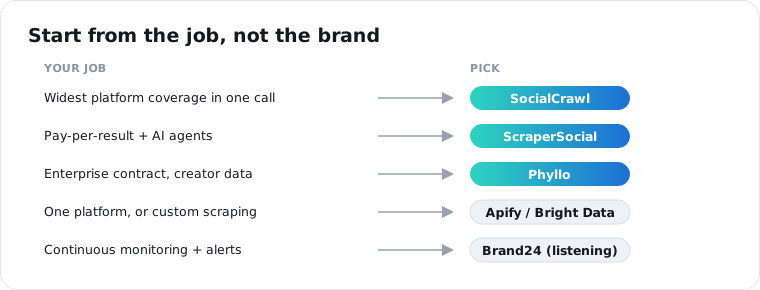
The question that sorts most of it: do you need one platform or many, and do you need a query or a monitor? Many platforms plus a query points at a unified search API. One platform points at that platform’s endpoint or a single scraper. A monitor points away from search APIs entirely.
Run one keyword across two APIs before you commit
Pick your top two and send the same keyword through both. Every provider here has a free tier or trial, so pull the same query, compare the platforms covered and the fields returned, and check a real bill against your monthly volume. The best social search API is the one that returns your platforms and your fields at a price your usage can sustain, not the one at the top of a vendor’s own list.
Frequently asked questions
What is a social search API?
A social search API lets you send a keyword or hashtag and get back matching public posts from one or more social platforms as JSON, without owning the accounts. It differs from a platform’s own API, which mostly returns your own data, and from a social listening tool, which monitors continuously. The best ones search many platforms from one request shape.
What is the best social search API in 2026?
It depends on the job. For the widest platform coverage in one call, SocialCrawl leads at 40-plus networks. For a clean pay-per-result API across a dozen social platforms with AI-agent support, ScraperSocial fits. For enterprise creator-economy integrations, Phyllo. For continuous brand monitoring with dashboards, a listening tool like Brand24 beats a raw search API.
What is the difference between a social search API and social listening?
A social search API is on-demand: you send a query and get results back once, like a database read. Social listening is continuous: you set keywords and a tool monitors platforms and alerts you on new mentions, usually with sentiment and a dashboard. Search APIs are cheaper and developer-facing; listening tools are pricier and built for marketing teams.
Is there a free social search API?
Partly. Most providers give a small free tier: ScraperSocial and SocialCrawl both include about 100 free credits, and Reddit’s own API is free within 100 queries per minute. The official X API removed its free read tier and now bills per post read. There is no unlimited free multi-platform social search API; free tiers are for testing, not production.
Can I search all social media platforms with one API?
Not literally all, but a unified social search API covers a dozen or more from one request shape. SocialCrawl advertises 40-plus platforms and ScraperSocial searches roughly a dozen social networks plus web and news. No single API covers every network, because each platform’s search changes and some, like the official Instagram API, expose almost no public search at all.
Why not just use each platform’s own search API?
You can, but you maintain one integration per platform, each with its own auth, rate limits, and pricing. X now charges per post read with no free tier, Reddit caps any search at about 1,000 results, and Instagram’s official API has no public content search. A unified social search API replaces that rack of integrations with one you never re-wire.