By Nikhil Kumar. Last updated August 2026.
If you are here, an integration broke and a LinkedIn API you relied on no longer answers. Proxycurl is gone, and there is no single drop-in to paste in its place.
Proxycurl shut down on July 4, 2025 after a LinkedIn lawsuit, and the replacements split into three models: real-time scrapers, dataset providers, and account-based APIs. Which one fits depends on whether you need live single-profile lookups, bulk records, or actions on your own account, and each carries different freshness, price, and legal exposure. This guide sorts the field honestly.
What happened to Proxycurl, and why does it matter for your replacement?
LinkedIn sued it out of existence, and how it died tells you which replacement to trust. Proxycurl’s operator Nubela was sued by LinkedIn in January 2025 over hundreds of thousands of fake accounts used to scrape millions of profiles, including non-public data. It settled, went dark on July 4, 2025, pulled its docs, and agreed to delete the data it held.
The case was never really about scraping being illegal. It was about how the data got collected.
What made Proxycurl vulnerable, per LinkedIn API’s migration guide, was three specific things: fabricated accounts at scale, access to non-public data, and packaging it all as a central index they resold. That combination is what a court acts on, and it is the lens to judge every alternative by.
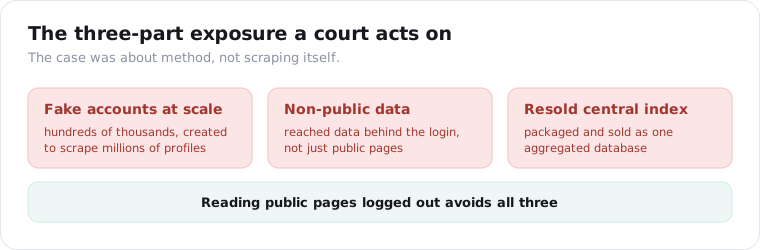
So the question is not just “what is cheapest.” It is “whose method is furthest from what got Proxycurl killed.”
There are two practical questions to ask any replacement before you commit. Does it read data a logged-out visitor can see, or does it reach behind a login, whether through fake accounts or your own. And does it keep personal data around indefinitely, or cap retention. A vendor that reads public pages and holds records briefly is a different bet from one that fabricates accounts and builds a permanent index, even if their JSON looks identical. The Proxycurl case turned those from nice-to-haves into the first things a careful buyer checks.
What are the three kinds of Proxycurl alternative?
Real-time scrapers, dataset providers, and account-based APIs, with real tradeoffs. Real-time scrapers pass a LinkedIn URL and fetch the profile live, the same model Proxycurl used, at roughly $1.50 to $4 per 1,000 profiles. Dataset providers sell hundreds of millions of pre-collected records at $0.005 to $0.20 each, cheaper but months to years stale. Account-based APIs run through your own authenticated LinkedIn account at a flat rate, which shifts the risk onto that account.
Each replaces a different Proxycurl job.
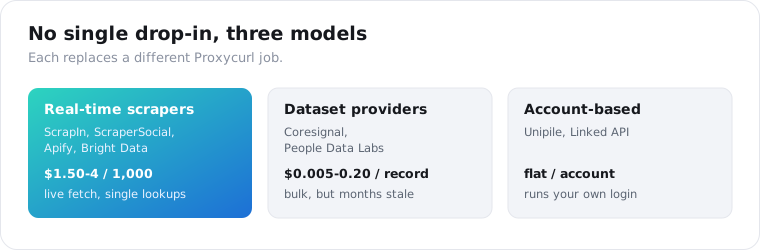
If you used Proxycurl for live single-profile lookups, you want a real-time scraper. If you used it to build a searchable index or enrich a database in bulk, a dataset provider fits better. If you need to act as your own account, that is the account-based lane.
The account-based lane deserves a warning, because it looks cheapest and carries the risk Proxycurl’s successors were built to avoid. Running data collection through your own logged-in LinkedIn account means the terms-of-service exposure sits on that account, and LinkedIn can restrict or ban it. For a personal profile you care about, that is a real cost that a flat monthly fee hides. It suits messaging and light own-account automation, not bulk data collection, and it is the wrong tool if losing the account would hurt.
What are the best Proxycurl alternatives in 2026?
The field, sorted by model and by what each does best. There is no single winner, because the three models solve different problems. The official route is not really one of them: LinkedIn’s Marketing Developer Platform and Sales Navigator APIs are partner-gated behind a three-to-six-month approval reserved for large enterprises, with development pushing first-year costs into the tens of thousands, which is exactly why this third-party market exists.
Real-time scrapers (the direct successors)
- ScraperSocial. Real-time LinkedIn reads across 38 endpoints, profile at 10 credits (about 5 to 12 cents) and people search at 5 credits, plus 32 other platforms in one schema. Reads public pages logged out, from $5/mo with 100 free credits. Best when you want the real-time job plus breadth and a compliance-forward method.
- ScrapIn (Reverse Contact). The most direct Proxycurl successor: a developer-first, real-time profile and email-to-profile API with a sub-two-second, no-cache pitch. No free tier; a $30 seven-day trial is the entry. Best as the closest drop-in for Proxycurl’s core.
- Apify. LinkedIn actors run roughly $2 to $10 per 1,000 profiles depending on the actor, pay-as-you-go with no monthly floor. Best when usage is spiky and you would rather not hold a plan.
- Bright Data. Enterprise proxy and dataset infrastructure with the strongest legal track record, around $1.50 to $2.50 per 1,000 records, with about 5,000 free records a month to test. Best for enterprise scale and blocked-heavy targets.
Dataset providers (bulk enrichment)
- Coresignal / People Data Labs. Hundreds of millions of pre-collected records for search and enrichment at fractions of a cent to about $0.20 per record. Best for building a database or ML features, with the freshness caveat.
Account-based (your own login)
- Unipile. Runs through your authenticated LinkedIn account from about EUR 49/mo for up to 10 accounts, which suits messaging and own-account workflows, and puts the terms-of-service liability on that account.
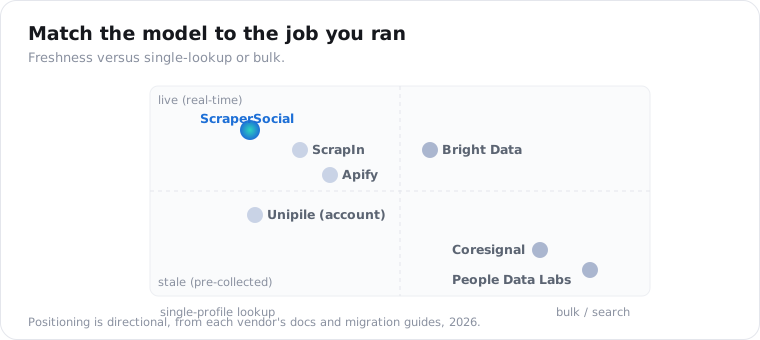
For a broader look at the real-time LinkedIn field beyond Proxycurl migration, the best LinkedIn scraping APIs post covers it in depth.
Which alternative replaces Proxycurl’s real-time lookups, and safely?
For the live URL-in, JSON-out job, pick a real-time reader whose method is clean. ScrapIn is the closest one-to-one drop-in, and ScraperSocial covers the same real-time reads with more breadth. The differentiator that matters after the lawsuit is collection method: reading public pages logged out sits furthest from the fake accounts and non-public access that got Proxycurl sued, while account-based tools move that risk onto your own login.
Method is now a purchasing criterion, not an afterthought.
Freshness is the second axis for this job. A real-time reader fetches the profile at request time, so a job change or a new headline is there the moment you call; a dataset provider returns a copy that can be months or years old. For a live lookup that difference is the whole point, which is why dataset vendors replace Proxycurl’s bulk search use case but not its single-profile one. If your code expected a current profile on every call, you want the real-time lane, not the cheaper stale rows.
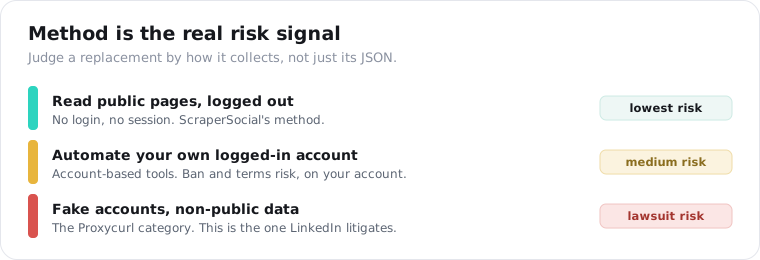
ScraperSocial reads the public profile the way a logged-out visitor does, with no member session and no fake accounts, and caps cached LinkedIn profile and people-search data at 30 days. That is the deliberate opposite of the three things that made Proxycurl a target. It is not a claim that any scraping is risk-free; it is a claim that method changes the exposure.
What comes back is the public profile itself: name, headline, current role and company, past positions, education, and location, the same fields Proxycurl returned. Completeness varies by person, because a public LinkedIn profile only shows what the member chose to make public, and a logged-out read sees less than a logged-in scrape did. That is the honest trade for staying on the safe side of the line. You read what is public, not what sits behind the login, and for most enrichment and search work that is enough.
How much do Proxycurl alternatives cost?
From cents per profile to enterprise contracts, and the model decides the shape. Real-time scrapers bill per profile fetched, dataset providers per record pulled, and account-based APIs a flat rate per connected account. Treat per-1,000 figures as directional, because a live fetch and a pre-collected record are not the same unit.
| Tool | Model | Price | Real-time | Best for |
|---|---|---|---|---|
| ScraperSocial | Per item | 10 cr (~5-12c) / profile, $5/mo entry | Yes | Real-time + breadth |
| ScrapIn | Per credit | $30 trial, no free tier | Yes | Closest drop-in |
| Apify | Pay-as-you-go | ~$2-10 / 1,000 (LinkedIn actors higher) | Yes | Spiky usage |
| Bright Data | Per record | ~$1.50-2.50 / 1,000 (5,000 free/mo) | Yes | Enterprise scale |
| Coresignal / PDL | Per record / plan | $0.005-0.28 / record ($49-98/mo entry) | No (bulk) | Bulk enrichment |
| Unipile | Per account | ~EUR 49/mo (up to 10 accounts) | Yes | Own-account workflows |
The honest reading: for occasional live lookups, per-profile pricing with a real free trial is the cheapest way in, which is where ScraperSocial and the pay-as-you-go actors win. For millions of records to sit in a warehouse, a dataset provider is cheaper per row, at the cost of freshness.
Run it against your own volume. Enriching 10,000 leads once is a dataset job, where a fraction of a cent per record beats paying real-time rates for freshness you do not need. Monitoring 200 profiles a day for job changes is the opposite: a live reader at a few cents each, with a free tier to start, beats buying a million-row dataset you will never fully use. Match the model to the cadence, not just the sticker price.
How do you migrate off Proxycurl?
Map the calls, abstract the source, and test before you cut over. Most real-time replacements keep Proxycurl’s URL-in, JSON-out shape, so migration is mostly swapping the base URL and remapping a handful of field names. The move that pays off later is wrapping the provider behind your own interface, so the next time a vendor disappears, it is a config change rather than a rewrite.
# Before: Proxycurl profile lookup (dead)# After: the same URL-in, JSON-out shape on a live readerimport requests
def get_profile(linkedin_url):    r = requests.get(        "https://api.scrapersocial.com/v1/linkedin/profile",        params={"url": linkedin_url},        headers={"Authorization": "Bearer sk_live_..."},    )    return r.json()["data"]  # remap the few fields your code reads
Proxycurl’s shutdown was a lesson in single-vendor dependency. Build the abstraction once and the next outage is a shrug.
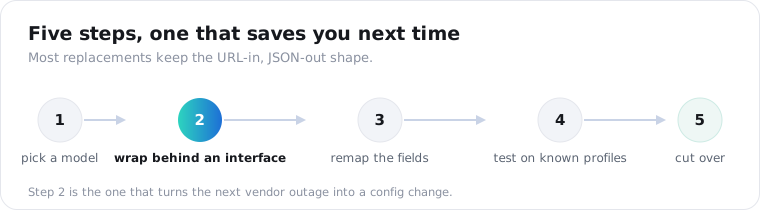
In practice the migration is a short checklist. Pick the model that matches your Proxycurl use case, real-time or dataset. Wrap the new provider behind a single function so nothing else in your code knows the vendor’s name. Remap the fields you actually read, which is usually a handful, not the full response. Then run both old expectations and new responses against a set of profiles you know by hand, and only cut over once the fields you depend on line up.
The remap itself is usually small. Proxycurl called it occupation and experiences; your new reader might call the same things headline and positions. Write a thin adapter that maps the new provider’s field names onto whatever your code already expects, so nothing downstream learns the vendor changed. That adapter is also where you handle a missing field gracefully, since no two providers populate exactly the same keys on every profile, and a field Proxycurl always returned may be optional on the replacement.
Start with a sample of profiles you already know, confirm the fields you depend on are present, and only then point production at the new endpoint. The quickstart covers auth and the response envelope.
Is it legal to use a Proxycurl alternative?
Reading public data is generally allowed; the method and what you store decide your exposure. The Proxycurl case did not make LinkedIn data off-limits, it punished fake accounts, non-public access, and a resold central index. A provider that reads public pages logged out and retains personal data briefly is a very different risk profile from one that fabricates accounts or automates yours.
I am not a lawyer, and none of this is legal advice.
The safe posture is the boring one: prefer public-page reads, keep a short retention window, hash or drop personal fields for aggregate work, honor deletion requests, and abstract your provider so compliance is a policy you can enforce in one place. Our own LinkedIn coverage caps profile and people-search retention at 30 days for exactly this reason.
Two rules keep most teams clear. First, treat every profile as personal data under GDPR and CCPA, which means a lawful basis for holding it, a retention limit, and a real way to honor a deletion request. Second, do not rebuild the thing that got Proxycurl sued: a permanent, resold central index of scraped members. Reading a public profile on demand and dropping it once you have used it is a very different posture from hoarding millions of records forever and selling access to the pile.
The short version
Proxycurl is gone, and the replacement depends on the job. For live single-profile lookups, ScrapIn is the closest drop-in and ScraperSocial covers the same reads with more breadth and a public-page method; for bulk records, Coresignal or People Data Labs; for own-account actions, Unipile. Judge each on collection method as much as price, because method is what ended Proxycurl. Abstract whatever you pick so the next outage costs you a config change, not another scramble like this one.
Frequently asked questions
Did Proxycurl shut down?
Yes. Proxycurl shut down permanently on July 4, 2025. LinkedIn’s parent Microsoft sued its operator Nubela in January 2025 over hundreds of thousands of fake accounts used to scrape millions of profiles, including non-public data. Nubela settled, took the API offline, pulled the docs, and agreed to delete the data it had collected. The endpoints do not work anymore, so any integration built on them needs a replacement.
What is the best Proxycurl alternative in 2026?
It depends on which of Proxycurl’s jobs you need. For real-time single-profile lookups, ScrapIn (now Reverse Contact) is the closest direct successor, and ScraperSocial covers the same real-time reads across LinkedIn plus 32 other platforms. For bulk enrichment, Coresignal or People Data Labs. For messaging on your own account, Unipile. There is no single drop-in; match the tool to the use case.
Is there a real-time Proxycurl replacement?
Yes. Real-time scrapers pass a LinkedIn URL and return the profile fetched live, the same URL-in, JSON-out model Proxycurl used. ScrapIn, ScraperSocial, Apify’s LinkedIn actors, and Bright Data all do this, priced around $1.50 to $4 per 1,000 profiles. The alternative is a dataset provider, which is cheaper per record but serves data that can be months or years old rather than a live fetch.
How do I migrate off Proxycurl?
Map each Proxycurl call to the equivalent on your new provider, then abstract the data source behind an interface so the next switch is a config change, not a rewrite. Most replacements keep the URL-in, JSON-out shape, so migration is mostly renaming fields and swapping the base URL. Test on a sample of profiles you know, and confirm the fields you depend on are present before you cut over.
Is scraping LinkedIn data legal after the Proxycurl case?
Reading public LinkedIn pages has generally held up in US courts, but the Proxycurl case shows where the line is. What drew the lawsuit was fake accounts, access to non-public data, and reselling a central index, not public reading itself. Prefer a provider that reads public pages logged out over one that automates a logged-in account, keep a short retention window for personal data, and get your own legal advice.
Is the Proxycurl API still working?
No. The API went dark on July 4, 2025 and the documentation was removed. There is no paid tier or grandfathered access; the service is gone under a legal settlement, and the team behind it has since moved to a different product, NinjaPear, that explicitly does not scrape LinkedIn, so there is no path back to the old API. If you are still calling the old endpoints, they are failing, and the fix is to move to one of the real-time, dataset, or account-based alternatives rather than waiting for it to return.
Replace one Proxycurl lookup
Take one profile URL your old integration used to fetch. Send it to the LinkedIn profile endpoint, remap the handful of fields your code reads, and confirm the shape matches before you cut over. The full alternatives list has the broader field, the quickstart issues a key in a minute, and 100 free credits are enough to test a real migration before you commit.