By Nikhil Kumar. Last updated October 2026.
There is no such thing as “the Facebook API.” There are at least four, and they do not talk to each other.
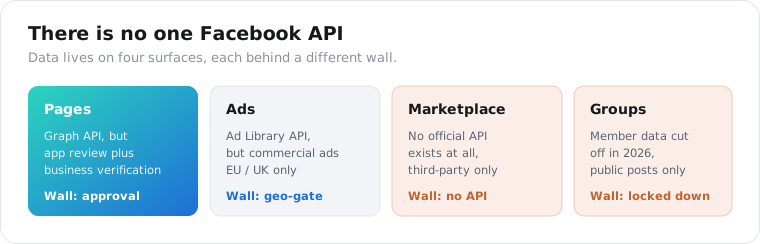
The best Facebook data API in 2026 depends on which Facebook you mean. Pages, ads, Marketplace, and groups each live behind a different wall: app review for pages, a geo-gate for ads, no official API at all for Marketplace, and a 2026 lockdown on groups. So the real question is not “which API” but “which surface,” and then which tool clears that wall. This guide ranks six by exactly that.
“facebook api” draws about 1,000 US searches a month, according to DataforSEO keyword data pulled in September 2026. Most of those searches assume one endpoint exists. It does not.
Why is there no single Facebook API?
Because Facebook’s data is split across surfaces that Meta governs differently. The Graph API reads pages and accounts you own. The Ad Library API is a separate, transparency-scoped system. Marketplace has no official API at all. Groups were locked down in 2026. Each surface has its own access rule, so “getting Facebook data” is really four different problems wearing one name.
This is the thing the other lists skip.
The Graph API is the one people picture, and it is the most gated. To read a page you do not manage, your app has to pass App Review for Page Public Content Access and clear Business Verification, a slow and selective process. Without it, the Graph API reads only your own pages.
The Ad Library is public but scoped to political transparency. Outside the EU and UK it returns political and social-issue ads only, so a US brand’s product ads are invisible to the API even though the website shows them to anyone. Our Facebook Ad Library API post walks that geo-gate in full.
Marketplace and groups are the two dead ends. Meta ships no Marketplace API, and in 2026 it cut third-party access to group member lists and member data entirely. Public group posts still read; members do not.
There is a fifth door, and it is only for researchers. Meta shut down CrowdTangle in August 2024 and replaced it with the Content Library, which serves public post data to approved academics and nonprofits through a university consortium. If you are not an accredited institution, it is not an option, and researchers have called the access process slow and narrow.
What are the best Facebook data APIs?
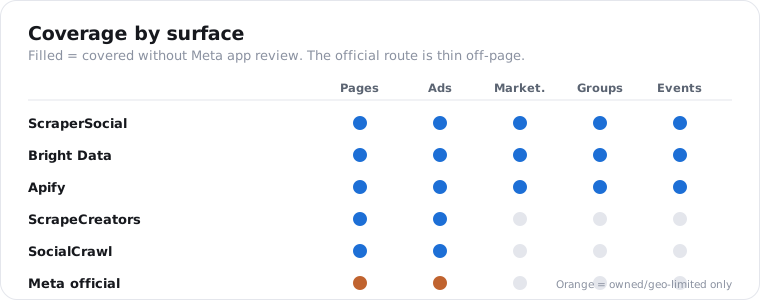
The six that most teams shortlist, ranked by how much surface they cover without Meta’s approval. The official APIs are free but gated and fragmented. The data APIs read the public pages across surfaces with one key. I have named the real trade on each.
- ScraperSocial. One normalized API across dozens of platforms with 23 Facebook endpoints spanning ads, pages, Marketplace, groups, events, reels, and reviews, from $5/mo. Best when you need more than one Facebook surface in a single schema.
- Meta’s official APIs (Graph + Ad Library). Free, authoritative, and the only route that can act on pages you manage, but app review, business verification, and the political-only ad gate box it in. Best for your own pages and EU ad transparency.
- Bright Data. An enterprise scraper with 15 Facebook templates and a 98.44% benchmark success rate, around $1.50 per 1,000 records. Best for bulk collection at real scale.
- ScrapeCreators. Pay-as-you-go with credits that never expire, strong on the Ad Library and pages, $47 for 25,000 credits. Best for ad-library-heavy work across platforms.
- Apify. A marketplace of Facebook actors priced per surface, roughly $2 per 1,000 posts to $6.60 per 1,000 pages. Best for custom or per-surface scraping jobs.
- SocialCrawl. A unified public-page reader that skips Graph app review, from GBP 15 for 2,500 credits. Best budget option for pages and posts.
The field runs wider than six. Decodo, Oxylabs, Zyte, SociaVault, and Data365 all sell Facebook data too. The six above are the ones I see teams shortlist once they sort by surface instead of by raw success rate.
Can you read a Facebook Page you do not own?
Not through the Graph API without approval. Meta’s Graph API only returns data for pages and accounts you manage, unless your app passes App Review for Page Public Content Access and clears Business Verification. That review is slow and selective, and it exists specifically to keep bulk commercial extraction out. To read any public page without it, teams use a data API that reads the public page directly.
Most projects hit this wall first.
You register an app expecting to pull a competitor’s page posts, and instead you are filling out a review application that explains your use case to Meta, with no guarantee of approval. For a lot of teams the review is where the project stalls.
A data API removes the review from the path. It reads what a logged-out visitor sees on a public page, so page posts, stats, reviews, photos, and follower counts come back as JSON with only the provider’s key. The trade is that you cannot act on the page, only read it, which is exactly what competitor research needs.
The Graph API is also throttled where it does work: roughly 200 calls an hour per user token, shared across pagination. A nightly sweep across a watchlist brushes that ceiling fast.
How does the Facebook Ad Library API actually work?
It returns political ads worldwide and commercial ads only for the EU and UK. Meta built the Ad Library for election transparency, so ad_type=ALL, the parameter that returns regular product ads, only works when the query targets EU member states or the UK under the Digital Services Act. Everywhere else the API serves political and social-issue ads exclusively, plus it needs government ID verification and app review to get a token.
So the API is excellent for its real job and frustrating for the one marketers want.
For election research it is genuinely good: seven years of political-ad history, disclosed spend ranges, funding details. For watching a US competitor scale a video hook, it returns nothing, because those commercial ads never enter the API outside Europe.
That gap is why the ad-library scraper category exists. A data API reads the public Ad Library website, which shows every advertiser’s active ads to anyone, and returns them as JSON in any country. The full mechanics, fields, and the spend data Meta never publishes are in our Facebook Ad Library API guide.
Is there a Facebook Marketplace or Groups API?
No official Marketplace API exists, and Groups lost member access in 2026. Meta has never shipped a Marketplace API, so every route to listing data is a third-party tool reading the public listing pages. Groups are worse off: the 2026 Graph API update cut third-party access to member lists and member data, and posting needs recurring admin consent. Public group posts still read; members and Marketplace have no official door at all.
These two surfaces are where the official-versus-third-party choice disappears.
For Marketplace there is nothing to choose between, because Meta offers no API. If you need listing prices, locations, or seller data, a data API that reads the public Marketplace pages is the only option, not the fallback. Providers expose it as a search endpoint plus an item endpoint.
Groups changed under everyone in 2026. Tools that used to pull member data stopped working when Meta closed that access to fight spam and scraping of personal data. What survives is the public post stream inside a group, which a group-posts endpoint still returns. If your old pipeline pulled members, it is not coming back on any route.
How much do Facebook data APIs cost in 2026?
A multi-surface Facebook project can start at $0 and run on a $5 plan. On ScraperSocial a new key comes loaded with 25 credits and needs no card; after that, $5 buys 1,000 credits a month, you can cancel whenever you like, and errored Facebook calls are never charged. The bigger saving is one key and one schema across ads, pages, Marketplace, groups, and events, where the alternatives are an approval queue or a separate actor per surface.
| Provider | How you pay | To start | Surfaces without app review |
|---|---|---|---|
| Meta Graph + Ad Library | Free, paid for in app review + verification | Free | Owned pages, EU ads only |
| ScraperSocial | Credits per item: 1-5 for most, 4 page stats, 4 transcripts | 25 free credits, then $5/mo | Ads, pages, Marketplace, groups, events |
| Bright Data | ~$1.50 / 1,000 records | 5,000 free/mo | Most surfaces |
| ScrapeCreators | Credit packs that never expire, $47 / 25,000 | Pay-as-you-go | Ads, pages |
| Apify | Per-surface actors, ~$2-6.60 / 1,000 items | 500 free pages | One actor per surface |
| SocialCrawl | Credit packs, GBP 15 / 2,500 | Free (100 credits) | Pages, posts |
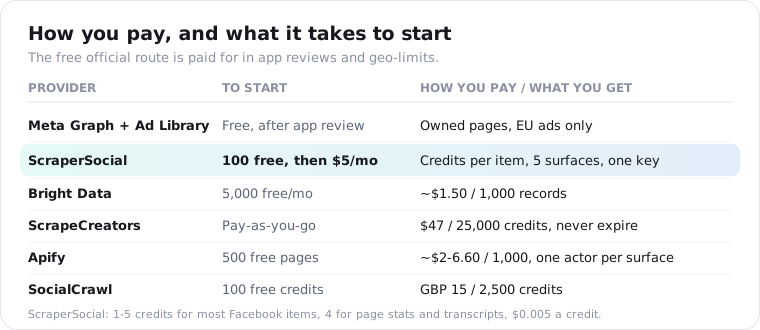
Look at the billing unit before the headline rate. Apify quotes a different price per surface, so a job that pulls pages, posts, and ads meters at three different rates. On ScraperSocial every Facebook surface draws from one credit balance, which keeps the forecast simple when a job touches several.
Price the common two-surface job from below. A competitor’s 50 latest page posts are 100 credits, their 50 live ads from the Ad Library search are 150, and a page-stats snapshot is 4, so one weekly check is 254 credits, about $1.27. Four of those a month is 1,016 credits, roughly $5.08, with no review queue and no second vendor.
If you need millions of Facebook records a month, line up a bulk per-record quote beside this one.
The official route’s real cost is not money. It is the review queue, the verification, the 60-day token refresh, and the surfaces it will never cover.
What should you check before you pick a Facebook API?
Three things the comparison tables skip: which surfaces it actually covers, how it handles Facebook’s login wall, and how fresh the data is. Facebook shows less and less to logged-out visitors every year, so a tool’s real coverage is narrower than its endpoint list suggests. These decide whether the data is usable, and price does not.
Start with surface coverage, because it is where lists mislead. A provider that advertises “Facebook data” might cover pages and ads but not Marketplace or groups, and you only find out after you integrate. Match the endpoint list to the surfaces your project actually needs before you sign up.
Then ask how it reads. Facebook gates more content behind a login each year, so a tool that only reads fully logged-out pages sees less than one that maintains authenticated sessions, and the second kind carries more account and legal risk. The provider’s method decides both what it can reach and what it exposes you to.
Freshness is the quiet one. Marketplace listings and live ads change hourly, so a cached or slow-refreshing source hands you stale prices and dead ads that look current. If your job is monitoring, the refresh rate matters as much as the field list.
None of this shows up in a per-1,000 rate. All of it decides whether the project ships.
What can one API pull across Facebook’s surfaces?
You send one request per surface to the same API and get JSON back, with no app review and no per-surface vendor. The API reads Facebook’s public pages and bills per item returned, so ads, page posts, Marketplace listings, group posts, events, and reels all come through one key and one schema. That is the point of a unified API on a platform this fragmented.
On ScraperSocial, the 23 Facebook endpoints group by surface: ads, pages, Marketplace, groups, events, media, and engagement.
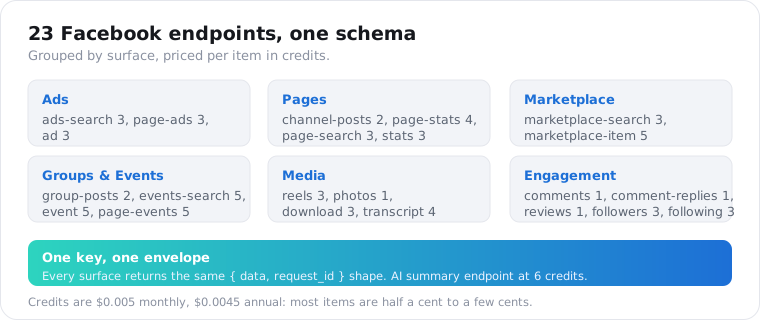
Here is the surface with no official API at all, Marketplace, in one call.
import requests
r = requests.get(    "https://api.scrapersocial.com/v1/facebook/marketplace-search",    params={"query": "road bike", "limit": 25},    headers={"Authorization": "Bearer sk_live_..."},)for item in r.json()["data"]:    print(item["title"], item["price_formatted"], item["location"])
Each listing comes back with its title, price, city location, thumbnail, sold and live status, and the seller’s name, and a separate item endpoint returns the same object for one listing by URL. No official endpoint returns any of that, which is the whole reason the Marketplace surface needs a data API. The Facebook Marketplace guide walks the full response and the compliance line.
Credits are $0.005 each monthly and $0.0045 annual. Most Facebook items run 1 to 5 credits, about 0.5 to 2.5 cents, with page stats and video transcripts at 4 credits each. The 25 free signup credits are enough to test one or two surfaces before you add a card.
Which Facebook data API should you pick?
Start with the surface, not the provider. If you only touch pages you own, Meta’s Graph API is free and official, so use it. If you need competitor ads, read the public Ad Library through a data API, not the political-only official one. For Marketplace, a third-party API is the only option. For several surfaces at once, one unified API beats stitching together per-surface scrapers: ScraperSocial for breadth in one schema, Bright Data for bulk scale, SocialCrawl for cheap page reads. Name the surface first, and the shortlist is short.
The most common real job spans two surfaces at once. A growth team usually wants a competitor’s page posts and their live ads together, and that pairing is exactly where the official route falls apart: the Graph API needs review for the page, and the Ad Library will not return the ads outside the EU. One data API that reads both surfaces is less work than an approval queue plus a separate scraper.
Frequently asked questions
What is the best Facebook data API in 2026?
There is no single best one, because Facebook data lives on separate surfaces with separate rules. For pages and posts you do not own, a data API like ScraperSocial, Bright Data, or SocialCrawl skips Meta’s app review. For competitor ads, a data API that reads the public Ad Library beats the geo-limited official one. For Marketplace, only third-party tools work because Meta has no Marketplace API. Pick by which surface you need first, then by price.
Can I read a Facebook Page I do not manage with the Graph API?
Not without approval. Meta’s Graph API only reads pages and accounts you own or manage unless your app passes App Review for Page Public Content Access plus Business Verification, which is a slow, selective process. Even then you get structured page data, not marketplace, not group members, and not non-EU commercial ads. To read any public page without that review, teams use a third-party data API that reads the public pages directly.
Is there an official Facebook Marketplace API?
No. Meta publishes no official Marketplace API, so every route to Marketplace listing data is a third-party scraper or data API that reads the public listing pages. Providers like ScraperSocial, Bright Data, and ScrapeCreators expose Marketplace search and item endpoints that return listings as JSON. Because there is no official option, the only choice is which third-party tool to use, not whether to use one.
Why does the Facebook Ad Library API only return political ads?
Because Meta built it for election transparency, not competitor research. Outside the EU and UK, the official Ad Library API returns only political and social-issue ads; regular commercial ads come back through ad_type=ALL just when the query targets EU member states or the UK, under the Digital Services Act. A US brand advertising to US audiences is invisible to the API even though its ads show on the public Ad Library website.
Can I still get Facebook Group member data in 2026?
No. Meta restricted the Groups API in 2026 so third-party apps can no longer pull member lists or individual member data, and posting into a group needs recurring admin consent. What remains readable is public group posts, which data APIs like ScraperSocial expose through a group-posts endpoint. Member-level data is off the table on every route now, official or third-party.
How much does it cost to scrape Facebook data?
Testing can cost $0. ScraperSocial’s signup grant is 25 credits without a card, and the paid plan is $5 a month, cancel anytime, at 1 to 5 credits for most Facebook items (comments are 1, page stats and transcripts 4), with failed calls not billed. Bright Data runs about $1.50 per 1,000 records, ScrapeCreators sells 25,000 credits for $47, and Apify prices per surface, from about $2 per 1,000 posts to $6.60 per 1,000 pages.
Name the surface, then pick the tool
Before you compare a single price, decide which Facebook you need: pages, ads, Marketplace, or groups. Owned pages point to Meta’s own Graph API. Everything else points to a data API that reads the public pages without app review. The quickest way to see the difference is to run one call against the surface with no official API at all, Marketplace, and read the listings back. The Facebook API hub lists every endpoint you can pull, a key comes from the quickstart in a minute, the pricing page has the per-item credit math, and 25 free credits cover a real pull across one or two surfaces before you spend anything.