By Nikhil Kumar. Last updated October 2026.
Most social media business ideas fail the same way: they need data the founder can’t get.
These 15 don’t. Each business idea built on social media data below uses public data a single API can return today, names the endpoints it needs, and prices one unit of output in credits. You’ll see who pays, what a report or alert costs to produce, and the limits to plan around before you write code.
What business can you build on social media data?
The ones that turn public posts, comments and profiles into an answer someone already pays for. That means reports, alerts and scores, not raw exports. A vetting report, a brand-mention alert or a review digest takes a few dozen API calls, costs cents to produce, and replaces hours of manual scrolling, which is the gap between your cost and your price.
The audience is huge and spread out. DataReportal counted 5.81 billion social media user identities at the start of October 2026, and the average user spends 19 hours and 18 minutes a week on social platforms.
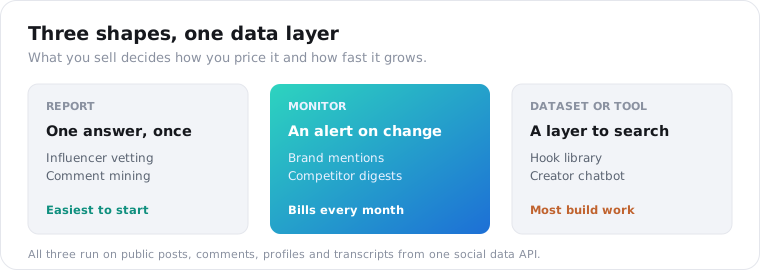
Nearly every idea here follows one of three shapes:
| Shape | What you sell | Examples below |
|---|---|---|
| Report | A one-off answer to a question | Influencer vetting, comment mining |
| Monitor | An alert when something changes | Brand mentions, competitor digests |
| Dataset or tool | A searchable or scored layer | Hook library, creator chatbot |
Reports are the easiest to start, because you can deliver the first ten by hand. Monitors are the easiest to grow, because they bill every month.
What makes a social data business idea worth building?
Four tests. Someone already pays for the answer, manually or with a clumsy tool. The data is public and reachable today. One unit of output costs a small fraction of what you can charge. And the output is something a customer notices when it’s wrong, so quality wins. Ideas that fail any test usually fail outright, however clever they sound.
The second test kills more ideas than the others. Private follower lists, DMs, Story viewers and who-viewed-my-profile data aren’t available to anyone, so skip any idea that needs them.
The third test is where a multi-platform API helps. GWI data in the same DataReportal study shows the typical user visits 6.66 social platforms a month, so most useful answers span several networks. One key and one response shape for all of them keeps your cost per report low.
Get a key from the quickstart and pull real data for one prospect first. Looking at an actual response tells you in ten minutes whether the fields you need are there.
Before writing code, sell the output by hand. Pull the data for three prospects, write the report in a doc, and ask for money. If nobody pays for the manual version, automation won’t fix that.
Which creator and influencer tools can you build?
Tools that help brands judge creators before paying them. Brands spend heavily here and still vet creators by scrolling profiles. A report built from a creator’s public profile and recent videos, showing median views, engagement and posting rhythm, answers the question a brand asks first: is this creator worth the fee? It costs about 6.5 cents of data to produce.
Demand is growing fast. In Influencer Marketing Hub’s May 2026 benchmark survey of 600+ respondents, 87.49% expected their influencer budget to increase, and 31% included TikTok in their plans.
1. Influencer vetting reports. Pull a creator’s profile stats and last 12 videos, then report median views, engagement rate and posting cadence. One report is 1 credit for the profile plus 12 for the videos, so 13 credits, about 6.5 cents.
Sell to agencies and in-house teams who vet dozens of creators a month.
2. Creator rate-card calculator. Use the same data to suggest a fair price per post from median views, not follower count. Median beats average here, because one viral video inflates an average for months.
3. Hook library for creators. Search a niche on TikTok, pull transcripts for the top videos, and catalogue the first sentence of each. Twenty videos cost 40 credits to find and 40 to transcribe, so about 40 cents per niche refresh.
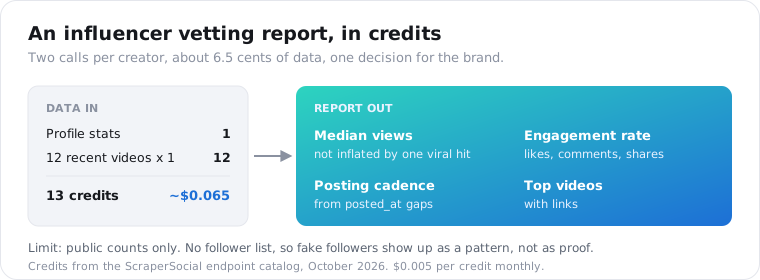
Two limits apply. Public profiles show counts, not follower lists, so you can flag odd engagement patterns but can’t prove fake followers. And roughly a third of TikToks have no caption track, per Apify’s May 2026 estimate, so a hook library misses voiceover-only and music-only videos.
Which brand and market intelligence products can you build?
Monitors that tell a brand when something changes: a competitor posts, a product gets mentioned, or customers complain in the comments. The buyer is usually a marketing or product team with no time to watch five networks. Price per alert is tiny, but the product bills monthly, so a handful of clients covers the data many times over.
It’s a large category with room at the small end. Coherent Market Insights sizes the social media listening market at $11.91 billion in 2026, and most of that spend goes to enterprise suites a local business or small SaaS can’t justify.
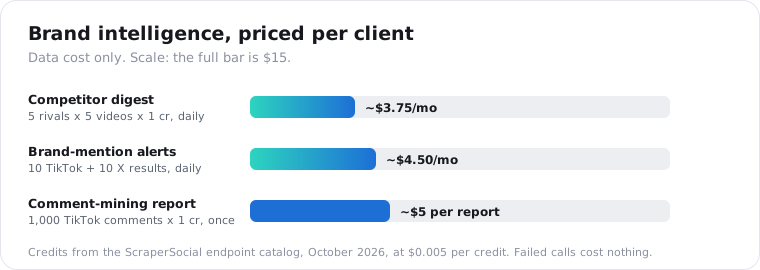
4. Competitor content digest. Check five competitors’ latest TikTok and Instagram posts every morning and send one weekly email with what they posted and what took off. Five competitors at 5 videos a day on TikTok is 25 credits a day, about $3.75 a month per client before any extras.
5. Brand-mention alerts for small businesses. Search TikTok and X for a brand or product name each day and alert on new mentions. Ten TikTok results at 2 credits and ten X results at 1 credit come to 30 credits a day, roughly $4.50 a month per brand.
6. Comment-mining reports. Pull the comments under a competitor’s top videos and summarize what customers praise and complain about. Comments cost 1 credit each on TikTok, Instagram and YouTube, so 1,000 TikTok comments is about $5 of data for a report a product team would otherwise build by hand.
Keep searches narrow. A brand name that’s also a common word returns noise, and you pay for every result, relevant or not. Exact product names and handles work better than generic terms.
Which review and e-commerce tools can you build?
Tools that watch reviews and products for sellers, app makers and local businesses. Reviews are high-intent data: each one is a customer explaining what went wrong or right. A monitor that flags new one-star reviews, or a scout that spots rising products, sells to people who check those pages by hand every day.
7. App review monitor. Pull new reviews from the App Store and Google Play for an app and its competitors, then tag them by topic. Reviews cost 1 credit each, so 500 a month is $2.50 per app.
Indie developers and small studios are the natural buyers.
8. Local business review digest. Track Google Maps and Tripadvisor reviews for a restaurant group or clinic chain and send a weekly summary. A full place record is 3 credits, and Tripadvisor reviews are 1 credit each.
9. Product trend scout. Search TikTok Shop and Amazon for a category each week and track which products gain reviews fastest. Each product returned costs 2 credits on either platform, so 100 products is 200 credits, $1 a week.
10. Price-drop alerts. Check Amazon product prices on a schedule and alert when one falls below a target. Each check is 2 credits.
The Amazon price tracker guide on this blog walks through the full build, including how often to poll.
Review data has one trap: volume swings. A product that goes viral can triple its review count in a week, and your cost with it. Cap how many reviews you pull per product per run.
Which B2B and recruiting data products can you build?
Products that turn public company and job data into sales or hiring signals. A company posting ten engineering roles in a week is a buying signal for recruiters and dev-tool vendors. Public job listings and company pages carry that signal, and sales teams pay for early, filtered versions of it instead of checking career pages themselves.
11. Hiring-signal alerts. Watch the LinkedIn jobs of a target account list and alert when a company opens roles in a function you sell to. Each job returned is 1 credit.
The LinkedIn jobs API guide on this blog covers which endpoints return job posts and what each one costs.
12. Local lead lists. Sell agencies and B2B sellers lists of one business type in one city, with contact details. The contacts endpoint runs the Google Maps search and adds emails and social profiles from each business’s website, at 3 credits a place, so a 200-place list costs 600 credits, $3.
Be careful with personal data in this category. A company profile is fine; a list of named people with contact details is personal data under GDPR and similar laws. Keep what you need, delete what you don’t, and give people a way out of your lists.
Which AI products can you build on social data?
Products where a language model does the reading and the data API supplies fresh, real posts to read. The model writes the summary, answers the question or scores the content. The API keeps it grounded in what creators and customers actually said, rather than what the model guesses. That grounding is the product; the model alone can’t provide it.
13. “Ask a creator” chatbot. Index a creator’s video transcripts and let fans or brands ask questions with answers that cite the exact video. A 50-video catalogue costs about $0.75 to load.
The RAG pipeline guide walks through the whole build.
14. Research agent for agencies. Give an AI agent search and comments tools and let it answer open questions, such as what buyers dislike about a competitor, with cited sources. The social media research agent guide shows how to cap its spend.
15. Content-angle generator. Pull the top-performing videos in a niche each week, summarize what they share, and suggest angles for a brand’s next posts. A TikTok summary costs 4 credits a video, so 20 summaries is 40 cents a week.
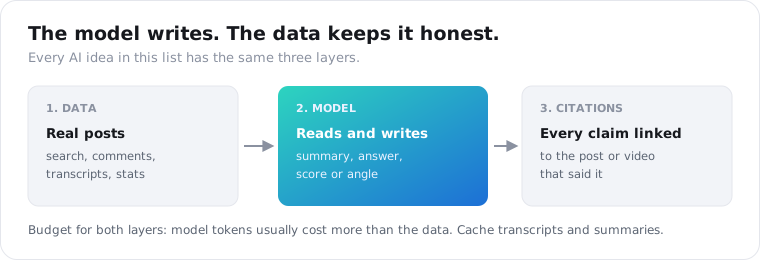
Model costs usually exceed data costs in this category. Budget for both, and cache any transcript or summary you might reuse, since the data never changes once a video is posted.
How do you pick the right idea for you?
Pick the idea closest to buyers you can already reach. A founder who knows agency owners should build the vetting report; one who knows app developers should build the review monitor. Distribution beats cleverness in small data products, because the data is available to everyone and the customer relationship isn’t.
Start on one platform, even if the idea spans several. TikTok alone covers creator vetting, competitor digests and hook libraries, and you can add Instagram or YouTube once customers ask for it.
Then pick the shape that matches your patience. A report earns money this week but needs selling every time. A monitor takes longer to land but bills monthly once it does.
Last, check the unit math before you fall for an idea. If one unit of output costs $10 in data and you can’t charge $50 for it, the idea needs a different buyer, not better code.
What does it cost to run a social data business?
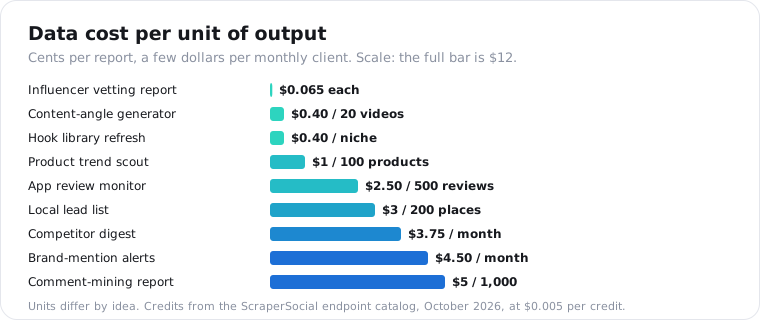
Data is usually the smallest line in the budget. Most of these products spend cents per report or a few dollars per client per month on API calls, while hosting, language model calls and your own time cost more. Price the product on the decision it saves the buyer, then check that one unit’s data cost is a small slice of that price.
| # | Idea | Endpoints | Data cost per unit |
|---|---|---|---|
| 1 | Influencer vetting report | TikTok profile + 12 videos | 13 credits (~$0.065) per report |
| 3 | Hook library | TikTok search + transcripts | |
| 4 | Competitor content digest | TikTok channel videos, daily | ~$3.75 per client per month |
| 5 | Brand-mention alerts | TikTok + X search, daily | ~$4.50 per brand per month |
| 6 | Comment-mining report | TikTok comments | ~$5 per 1,000 comments |
| 7 | App review monitor | App Store + Google Play reviews | $2.50 per 500 reviews |
| 9 | Product trend scout | TikTok Shop + Amazon search | $1 per 100 products |
| 12 | Local lead list | Google Maps contacts | $3 per 200 places |
| 15 | Content-angle generator | TikTok summaries | $0.40 per 20 videos |
All figures use $0.005 per credit on the $5 monthly plan and the credit prices listed on the pricing page. Failed calls, such as a deleted video or a 404 for a caption-less TikTok, cost nothing.
Watch the per-minute limit as you grow, not just the bill. The rate-limit docs cap the monthly plan at 200 requests per minute, so spread daily jobs for many clients across the day rather than running them all at once.
What are the legal and data limits?
Build only on public data, read logged out, and collect the fields your product needs. Private accounts, DMs, follower lists and Story viewers are off limits for every provider. Usernames and comments are personal data under GDPR and similar laws, so store them deliberately and delete what you don’t use. And sell analysis, not copies of other people’s content.
A few product-specific limits matter too. Transcripts depend on captions on most platforms: TikTok works well, Instagram reels are transcribed per started minute of video at a higher price, while Facebook and X transcripts still come back as 404s.
Each list call returns up to 50 items, and some endpoints don’t page at all, so products that need thousands of comments should plan to sample. And some data changes access rules over time, so avoid building your whole business on one platform’s endpoint.
This isn’t legal advice. If your product touches hiring decisions, credit, health or children’s data, get a lawyer before you launch, not after.
Frequently asked questions
What business can I start with social media data?
The ones that sell a finished answer, not raw data. Influencer vetting reports, brand-mention alerts, competitor content digests, app review monitors and comment-mining reports all work because a buyer already pays for that answer today. Each one turns a few dozen API calls into a report or alert worth far more than the data inside it, which is where the margin comes from.
Is it legal to build a business on social media data?
It depends on what you collect and how you use it. Stick to public data, never log in to scrape, collect only the fields your product needs, and treat names and usernames as personal data under laws like GDPR. Sell analysis rather than copies of other people’s content, and check your data provider’s terms. For anything high-volume or regulated, talk to a lawyer first.
How much does it cost to run a social data SaaS?
Usually cents per unit of output. An influencer vetting report built from a TikTok profile and 12 recent videos costs 13 credits, about 6.5 cents. A daily competitor digest for one client runs a few dollars a month. Data is rarely the big cost; your time, hosting and any language model calls usually cost more than the API.
Can these ideas run on the official platform APIs?
Mostly no. The official APIs from TikTok, Instagram and LinkedIn mainly cover accounts you own or partners they approve, so most of these ideas, which look at other people’s public content, can’t run on them. A third-party data API reads public pages for you behind one key, so you skip separate approval processes for each network.
Which social media data business is easiest to start?
An app review monitor or an influencer vetting report. Both have a clear buyer, need only one or two endpoints, and produce a report you can hand-deliver before you automate anything. App reviews cost 1 credit each, and a vetting report costs about 6.5 cents in data, so you can test demand with a few paying customers before writing much code.
Can I resell raw social media data?
Be careful here. Reselling raw dumps of other people’s posts raises copyright, privacy and terms-of-service questions, and many data providers restrict it in their terms. The safer and more common model is selling analysis: scores, summaries, alerts and trends built on the data. Check your provider’s terms before you sell anything that looks like a copy of the source.
Pick one idea and sell it by hand
Choose the idea closest to a customer you can reach this week, pull the data for three of their competitors or creators, and deliver the first report as a doc. If they pay for that, automate it. A new key comes with 25 free credits, enough for one full vetting report. Get your API key and build the first one today.