By Nikhil Kumar. Last updated August 2026.
Every social listening dashboard is only as good as the data feed under it. That feed is the hard part, and it is the part most build guides skip.
A social listening API is the data layer you query by keyword, hashtag, or account to pull the posts, comments, engagement stats, and author profiles a monitoring tool runs on. To build one you need three things: keyword and hashtag search across the platforms you care about, a way to pull comments and engagement per post, and profile context for the authors. Everything else, the charts and the alerts, sits on top of that.
What do you actually need to build a social listening tool?
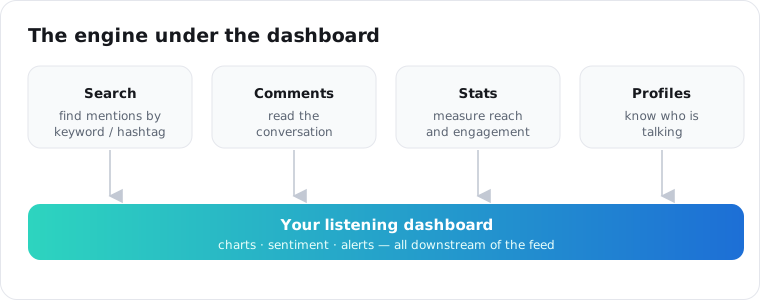
You need four data primitives and a place to put them: search to find mentions, comments to read the conversation, stats to measure reach, and profiles to know who is talking. Wire those into storage and you have the engine. The dashboard, sentiment scoring, and alerting are all downstream of getting that data reliably, which is exactly where in-house projects stall.
Here is what I keep seeing. Teams start with the fun part, the UI, and treat the data feed as a weekend task. Then the feed is what eats the next three months, because the platforms fight collection at every step.
What is a social listening API, exactly?
It is an API that returns social posts, comments, and profile data filtered by a search term or an account, so you can monitor mentions without operating your own scrapers. You send a keyword or hashtag and get back structured results; you send a post URL and get its comments and engagement. The term draws about 70 US searches a month at a high commercial CPC, because the people looking are builders, not browsers.
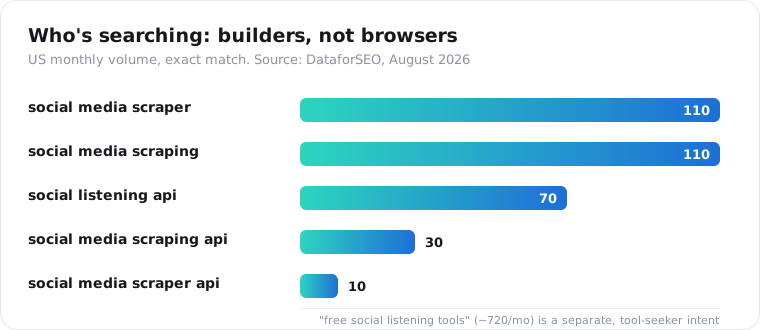
Worth naming the split: “free social listening tools” pulls roughly 720 searches a month, but that is people who want finished software, not a data feed. This post is for the ones building the software.
The market that runs on this data is not small. Research and Markets puts the social media listening market at $12.15 billion in 2026, up from $10.37 billion in 2025, a 17.1% annual growth rate; Mordor Intelligence estimates it a little lower at $10.91 billion. The firms disagree on the exact figure, but every one shows double-digit growth. Each of those tools needs a feed underneath it, and that feed is what this article is about.
Should you build the data layer or buy it?
Buy the data layer unless collection is your actual product. Building it means writing and maintaining a separate scraper for every platform, each with its own login walls, rate limits, and layout changes that break your parser without warning. A social listening API gives you one request shape across platforms, so you integrate once instead of babysitting a brittle collector per platform. Build the parts that make your tool different; buy the commodity feed.
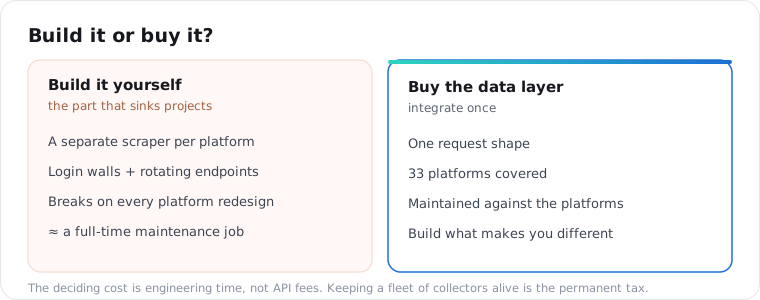
The math that changes minds is engineering time, not API fees. One developer keeping a fleet of scrapers alive is a permanent tax. A single integration you never patch for a platform redesign is the opposite.
What makes listening data hard to collect?
The platforms actively resist collection, and each one resists differently. TikTok and Instagram gate content behind login walls and rotate their internal endpoints, so a scraper that worked last month returns empty this month. LinkedIn is the most defended and will flag an account that reads too many profiles. Threads is young enough that its data shapes still shift. A keyword that maps cleanly on one network returns nothing on another, because the search surface is not the same.
Then there is the boring failure mode that actually sinks projects: a platform ships a layout redesign, your parser silently returns partial data, and your dashboard shows a dip in mentions that is not real. You are now debugging a scraper instead of shipping features.
This is the case for buying the data layer in one line. Someone has to keep every collector alive against a platform that changes without notice. If that someone is on your team, it is most of a full-time job. A maintained API moves that work off your plate and gives you a stable contract to build against.
How do you build the listening pipeline?
The core loop is search, then enrich, then store. You search a keyword to find matching posts, pull comments and stats for the ones worth tracking, attach author profiles, and write it all to your database on a schedule. For large pulls you hand the job to an async endpoint and let a webhook tell you when the results are ready, instead of holding a request open.
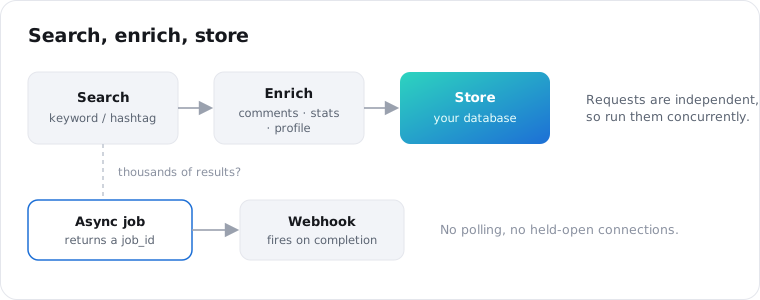
A minimal version is a handful of calls:
import requestsBASE = "https://api.scrapersocial.com/v1"H = {"Authorization": "Bearer sk_live_..."}
# 1. find mentionshits = requests.get(f"{BASE}/tiktok/search",                    params={"query": "your brand", "limit": 50}, headers=H).json()
# 2. enrich each mention with its commentsfor post in hits["data"]:    comments = requests.get(f"{BASE}/tiktok/comments",                            params={"url": post["url"], "limit": 50}, headers=H).json()    store(post, comments["data"])
Requests are independent, so you run them concurrently and stay under your plan’s per-minute limit. When a single query needs thousands of results, the list endpoints switch to an async job that returns a job_id and calls your webhook on completion, so you are not polling.
Which platforms can one API cover?
One API covers 33 platforms with the same request shape, which is the whole point for listening. Brand mentions do not respect platform boundaries, and with 5.79 billion social media user identities as of April 2026, per DataReportal, a monitoring tool that only watches one network misses most of the conversation. The core networks are all there — TikTok, Instagram, Facebook, X, LinkedIn, Threads — and so are the two that in-house builds usually punt on: YouTube has all four listening primitives (search, comments, stats, and channel profiles, plus comment replies and transcripts on top), and Reddit has keyword search, post comments, and user profiles. Search, comments, stats, and profiles work the same way on each, so adding a platform to your coverage is a config change, not a new integration.
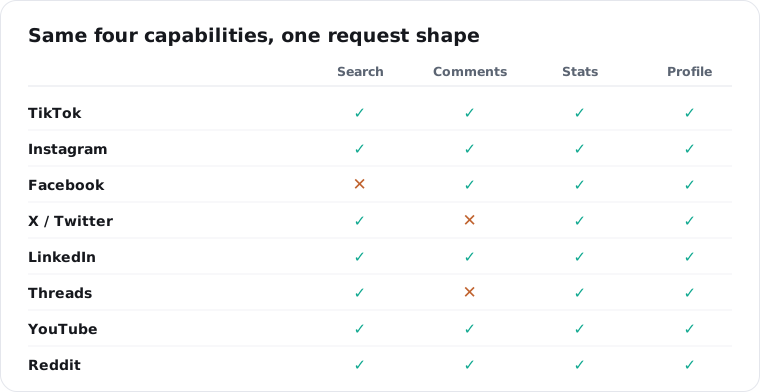
Coverage is not identical everywhere, and pretending otherwise sets you up to ship gaps. Facebook has no post keyword search — page, event, marketplace, and ad search all exist, but you cannot search post content by keyword — and neither X nor Threads has a comments endpoint. A good listening build plans around those holes instead of discovering them in production.
How much does it cost to run?
You pay per item returned, in credits, so a listening workload costs what it collects. Search results and comments are a few credits each, stats are one to five depending on platform, and credits run $0.005 on the monthly plan or $0.0045 on annual. A run that pulls 500 mentions and 50 comments on each is a predictable line item you can model before you commit, not a surprise invoice.
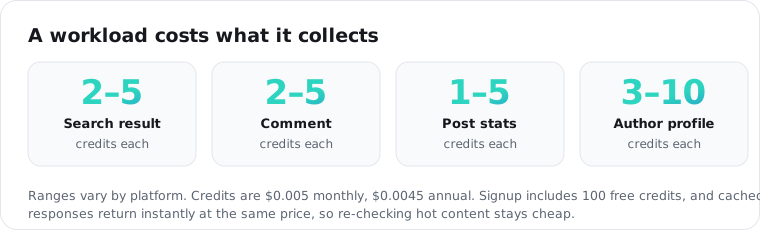
Two things keep the bill down. Cached responses return instantly and let you re-check hot content cheaply, and the same viral post requested by many of your own queries is collected once, not repeatedly. You start with 100 free credits, enough to run a real keyword through the loop before deciding anything.
| Listening job | Endpoint | Credits per item |
|---|---|---|
| Find mentions (TikTok) | /tiktok/search | 4 per result |
| Find mentions (X) | /twitter/search | 2 per result |
| Read the conversation | /{platform}/comments | 2–5 per comment |
| Measure reach | /{platform}/stats | 1–5 per post |
| Identify the author | /{platform}/profile | 3–10 per profile |
Start with one keyword
Run a single keyword through the search endpoint and watch the mentions come back, then add comments to one of them. The social listening use case has the full pipeline with pagination and credit math worked out, and 100 free credits are enough to prove the loop before you build the dashboard around it.
Frequently asked questions
What is a social listening API?
It is an API that returns social posts, comments, engagement stats, and profiles filtered by keyword, hashtag, or account, so you can monitor brand and topic mentions programmatically. Instead of running your own scrapers, you query the API and get structured JSON back, then feed it into your own dashboard, alerts, or analysis.
Can I build social listening without scraping the platforms myself?
Yes. A social listening API handles collection for you, so you never write or maintain a scraper. You send a keyword or a post URL and receive clean data across 33 platforms, from TikTok and Instagram through YouTube and Reddit. That removes the part of the project that usually breaks, the per-platform collectors, and leaves you to build the analysis layer.
Which platforms can a social listening tool cover?
With one API you can cover 33 platforms using the same request shape, including TikTok, Instagram, Facebook, X, LinkedIn, Threads, YouTube, and Reddit. Coverage differs by platform: Facebook has no post keyword search, and neither X nor Threads has a comments endpoint. A solid build accounts for those gaps rather than assuming every capability exists everywhere.
How much does a social listening API cost?
You pay per item returned in credits, priced at $0.0045 to $0.005 each. Search results and comments are a few credits each, and stats are one to five per post depending on platform. A workload is priced by what it collects, so a run of 500 mentions is a number you can estimate up front. Signup includes 100 free credits.
Do I need real-time data for social listening?
Rarely. Most listening use cases tolerate data that is minutes to hours old, and caching that content makes re-checks instant and cheap. When you do need the freshest read, a parameter bypasses the cache at the same price. Design for cached-by-default and force fresh only on the queries that truly need it.
How do I handle large listening pulls without timeouts?
Use the async job path. When a list request would return thousands of items, the API returns a job_id immediately and calls your webhook when the results are ready, so you collect at scale without holding a connection open or polling in a loop. Small pulls run synchronously; only large ones go async.