By Nikhil Kumar. Last updated August 2026.
ScrapeCreators is fast, broad, and honest about being raw. That is exactly why “ScrapeCreators alternatives” is a specific search, not a complaint.
The best ScrapeCreators alternative depends on what you are optimizing for. If you want the widest raw feed and credits that never expire, ScrapeCreators is already the answer. If you want one normalized response shape across platforms, with transcripts and summaries built in, a schema-first social API fits better. If you want caption-less video transcription or arbitrary-site scraping, the answer is a different tool again. Match the alternative to the job.
Why do people look for a ScrapeCreators alternative?
The schema, the cache, and the scale bill. ScrapeCreators returns raw platform JSON, so every endpoint has its own shape and you own the normalization code. It runs live on every call with no cache, so repeat queries pay full price each time. And its pay-as-you-go credits are cheap per unit but add up on high-volume pulls, a limitation an independent review of ScrapeCreators calls out directly.
None of that makes it a bad tool. It is the raw-data bet, taken on purpose.
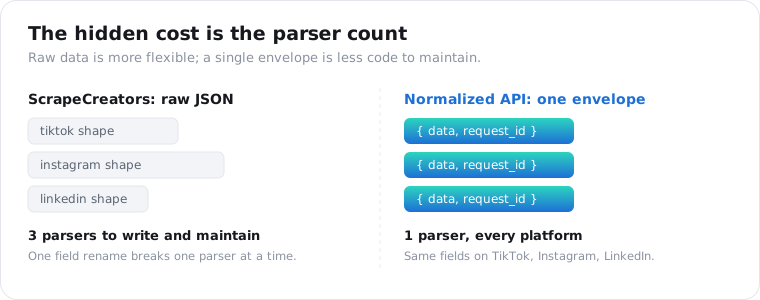
The complaint I hear most is normalization drift. Five platforms return five shapes, so you write five parsers, and when one platform changes a field, one parser breaks while the others keep working. You maintain the seams forever.
The second reason is processing. ScrapeCreators offers transcripts on some platforms but no AI summaries, because it returns raw data by design. If your pipeline needs a summary, you build that leg yourself.
When should you stick with ScrapeCreators instead?
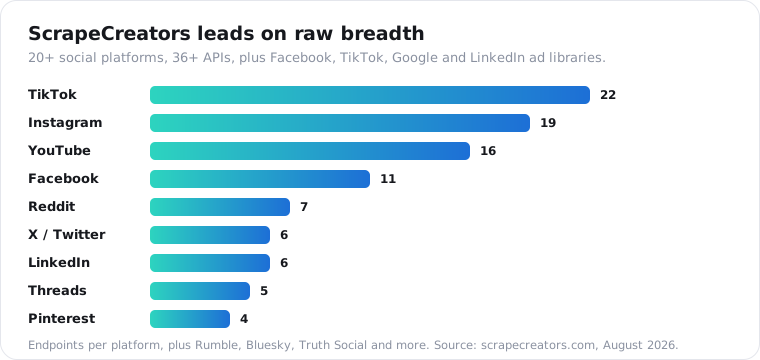
Keep ScrapeCreators when breadth and raw access are the point. Its own site lists more than 20 social platforms and 36-plus APIs, including Facebook, TikTok, Google, and LinkedIn ad libraries that most social APIs do not touch. If you need the TikTok ad library, or Rumble, or SoundCloud, that breadth is the feature.
Spiky workload? Pay-as-you-go credits that never expire are the honest fit. There is no monthly plan to waste in a quiet month, which a subscription cannot match.
And if you genuinely want the raw, unmodified platform response to parse yourself, that is what ScrapeCreators hands you. A normalized API takes that choice away in exchange for consistency. So I would not switch to save a few dollars if raw breadth is what you came for. I would switch the part of the job that wants a clean schema and leave the rest.
What are the best ScrapeCreators alternatives, and who is each for?
Five tools come up over and over when people leave ScrapeCreators. They are genuinely different from each other, so I have listed the one thing each does better than the rest.
- ScraperSocial. One normalized social API across 33 platforms and 227 endpoints, with the same request shape everywhere, transcripts and AI summaries as endpoints, and a $5 monthly entry. Best when you want processed social data without writing a parser per platform.
- Apify. A marketplace of more than 24,000 actors you assemble and run yourself, on infrastructure with proxies and scheduling built in. Best for custom or long-tail scraping beyond social.
- Bright Data. Proxy-backed data infrastructure with a pay-per-record social scraper around $1.50 per 1,000 records. In an independent 75,000-request benchmark across five social platforms, it posted an 88% success rate. Best when the target blocks hard and you need volume through it.
- Supadata. A transcript-first API that generates transcripts for caption-less video with an AI fallback at 2 credits per minute, plus web crawling. Best when transcription, not comments or profiles, is the whole job.
- SocialKit. Social APIs with deep YouTube coverage and AI summaries on every platform. Best when YouTube or generic video-file transcription is core to your product.
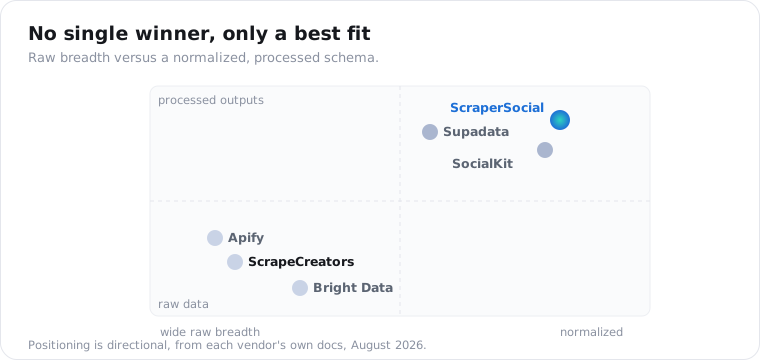
If your job is “get social data across platforms in one shape without babysitting parsers,” the first row is the fit. If it is “scrape anything, anywhere,” it is Apify. If it is “transcribe video at scale,” it is Supadata.
What should you look for in a ScrapeCreators alternative?
Look for a consistent response shape, a real cache, and processed outputs. Those three are exactly what a raw-data API leaves for you to build. A tool that returns a different JSON shape per platform, live on every call, recreates the maintenance and the bill you were trying to escape.
The signals worth checking before you commit:
- One request and response shape across platforms, so a comments call looks the same everywhere and you write one parser.
- Documented caching with a visible cache header and a freshness bypass, so repeat queries are fast and cheap instead of full price every time.
- Processed endpoints like transcripts and AI summaries, if your pipeline needs them, instead of raw data plus your own extraction code.
- Predictable pricing you can model against your call list, whether that is pay-as-you-go or a flat subscription.
ScrapeCreators scores high on breadth and low on the first three, on purpose. That is the whole trade.
ScrapeCreators vs a normalized social API: the cost comparison
Raw pulls are cheaper per record; processed data flips the math. ScrapeCreators sells credits at roughly $1.88 per 1,000 on its $47 pack and $0.99 per 1,000 on its $497 pack, with about one credit per request and no expiry. A normalized API like ScraperSocial bills per item returned, from 1 to 42 credits, because a transcript or a summary is real work the raw price does not include.
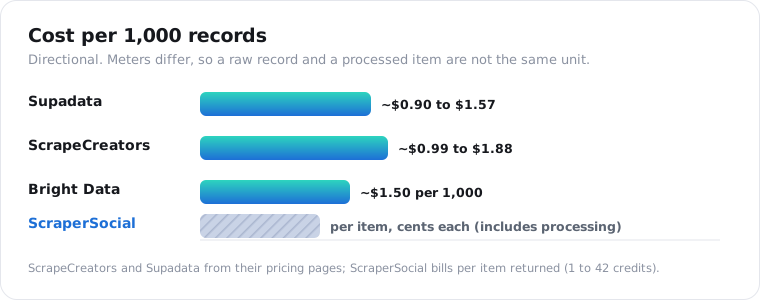
Here is the honest version in a table. Treat the per-1,000 figures as directional, because each vendor meters a different thing.
| ScrapeCreators | ScraperSocial | Supadata | |
|---|---|---|---|
| Entry | $10 (Solo Dev) | $5/mo (1,000 credits) | $5/mo (300 credits) |
| Model | Pay-as-you-go credits | Per item, in credits | Per credit, monthly plan |
| At scale | ~$0.99 per 1,000 | ~1-42 credits per item | ~$0.90 per 1,000 |
| Response | Raw platform JSON | One normalized envelope | Transcript-shaped JSON |
| Caching | None, live every call | Documented, x-cache header | Not documented |
| Transcripts / summaries | Transcripts only | Both, built in | Transcripts with AI fallback |
| Credit expiry | Never | End of billing period | Monthly, no rollover |
| Best for | Raw breadth | One schema, processed | Caption-less video |
The free trials also differ. ScrapeCreators gives 100 credits one time; ScraperSocial gives 100 trial credits with no card; Supadata gives 100 credits a month. Enough on any of them to price a real batch.
How do you migrate off ScrapeCreators?
Swap each raw endpoint for the matching normalized one, and delete the parser. Where you called a TikTok endpoint, an Instagram endpoint, and a LinkedIn endpoint and reconciled three output shapes, you now call three endpoints that return the same envelope. The field-mapping code you wrote to normalize raw responses goes away.
What you delete is more telling than what you add. Most of it is the defensive code around raw data: the null checks for a field one platform renamed, the try blocks for the endpoint that returns an array here and an object there.
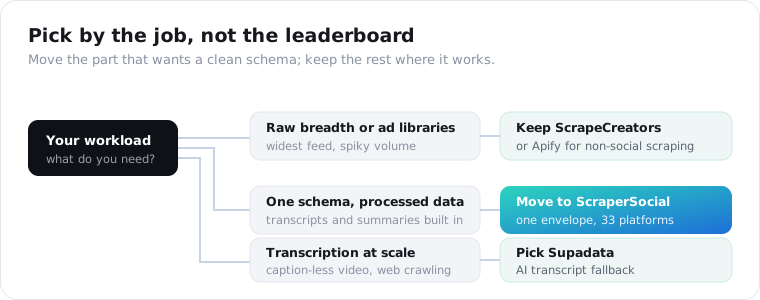
The move is usually smaller than it looks:
# Before: one raw endpoint per platform, each with its own output shape to parse# After: the same request and response shape on every platformimport requestsBASE = "https://api.scrapersocial.com/v1"H = {"Authorization": "Bearer sk_live_..."}
for platform in ["tiktok", "instagram", "linkedin"]:    r = requests.get(f"{BASE}/{platform}/comments",                     params={"url": post_url, "limit": 50}, headers=H)    store(r.json()["data"])
Start with your highest-volume endpoint, move that one, and compare a week of output and cost. If the single schema saves you enough parser maintenance, move the rest. Keep the raw, long-tail platforms on ScrapeCreators, because raw breadth is still what it does best.
The short version
ScrapeCreators is the right tool for wide, raw, spiky social pulls, and the wrong one when you need a single schema, built-in processing, or caching. If you want processed social data across platforms in one shape, a normalized API costs a parser less to run and integrates once. If you want the widest raw feed and ad libraries, ScrapeCreators earns its price.
Frequently asked questions
Is there a cheaper alternative to ScrapeCreators?
It depends on the meter, not the sticker price. ScrapeCreators sells pay-as-you-go credits at about $1.88 per 1,000 on its $47 pack and $0.99 per 1,000 on its $497 pack, and they never expire. Supadata reaches roughly $0.90 per 1,000 at scale. ScraperSocial starts at $5 a month for 1,000 credits with per-item billing. For raw bulk pulls ScrapeCreators is hard to beat; for processed data the cheapest raw price is not the whole cost.
What is the best ScrapeCreators alternative?
It depends on the job. For one normalized response shape across many platforms with transcripts and summaries built in, ScraperSocial fits. For custom or long-tail scraping, Apify. For heavily blocked targets at enterprise scale, Bright Data. For caption-less video transcription, Supadata. Match the tool to whether you want a clean schema, raw scale, or transcript depth.
ScrapeCreators vs ScraperSocial: which is better?
ScrapeCreators is breadth-first: 20-plus platforms and 36-plus APIs including ad libraries, with raw platform JSON and credits that never expire. ScraperSocial returns one normalized envelope across 33 platforms and 227 endpoints, with transcripts and AI summaries as endpoints and documented caching. Pick ScrapeCreators for the widest raw feed; pick ScraperSocial to learn one response shape and never parse a second.
Why does ScrapeCreators return raw JSON?
By design. ScrapeCreators returns the platform’s own response so you get everything the source exposes, unmodified. The tradeoff is that each endpoint has its own shape, so you write and maintain the normalization yourself. A normalized API like ScraperSocial does that mapping once and returns the same fields everywhere, which is less flexible and less work.
Is ScrapeCreators worth it?
For fast, broad, raw social data, yes. It covers 20-plus platforms, includes ad libraries, runs with no rate limits, and sells credits that never expire, which suits spiky workloads. It is a weaker fit when you need one consistent schema, built-in transcripts or summaries, or documented caching, because it returns raw data live on every call by design.
Can I replace ScrapeCreators with one API?
For social data, usually yes. A normalized social API exposes one request shape across platforms, so a stats call, a comments call, and a search call look the same on TikTok, Instagram, LinkedIn, and the rest. You swap each raw endpoint for the matching normalized one and delete the per-endpoint field mapping you were maintaining.
Try one normalized endpoint
Run one platform through a normalized API before you decide anything. The ScraperSocial vs ScrapeCreators comparison lays out the head-to-head, the full alternatives list covers the rest of the field, the quickstart gets you a key in a minute, and 100 free credits are enough to move your highest-volume endpoint and check a real bill against ScrapeCreators.