By Nikhil Kumar. Last updated October 2026.
There is a free, official TikTok API. You are just not allowed to use it.
The best TikTok data API in 2026 is a third-party one, because TikTok’s own API is closed to commercial use. The Research API is academics-only, the Commercial Content API covers ads, and neither serves a product. So every commercial TikTok project runs on a third-party data API, and the real choice is which one. This guide ranks six by the things that decide it: coverage, price, and how you are billed.
“tiktok api” draws about 1,900 US searches a month, according to DataforSEO keyword data pulled in September 2026. Most of those searches end at an official API the searcher cannot legally use.
Why is there no free TikTok API for commercial use?
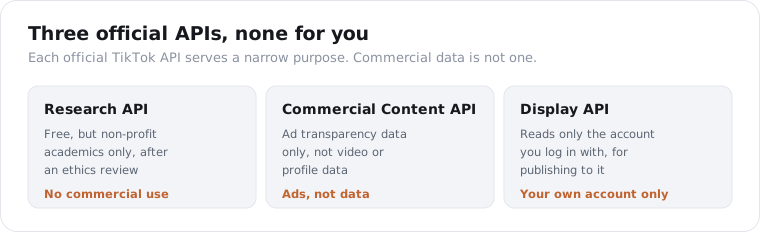
Because TikTok’s three official APIs each serve a narrow purpose, and none of them is general commercial data. The Research API is free but limited to non-profit academics. The Commercial Content API returns ad transparency data, not video or profile data. The Display API only reads the account you log in with. There is no self-serve endpoint where a developer signs up and queries public TikTok data.
This is the wall every TikTok project hits.
The Research API is the one people find first, and it stops them cold at the eligibility screen: you must be a non-profit academic in an approved region, with an ethics-reviewed proposal, after a review that runs weeks to months. Our TikTok Research API vs a data API guide walks that gate in full.
Unlike X, YouTube, or Instagram, TikTok never shipped a public developer console for general data. So for any commercial or product use, a third-party data API that reads public TikTok pages is not a workaround. It is the only category that exists.
What are the best TikTok data APIs?
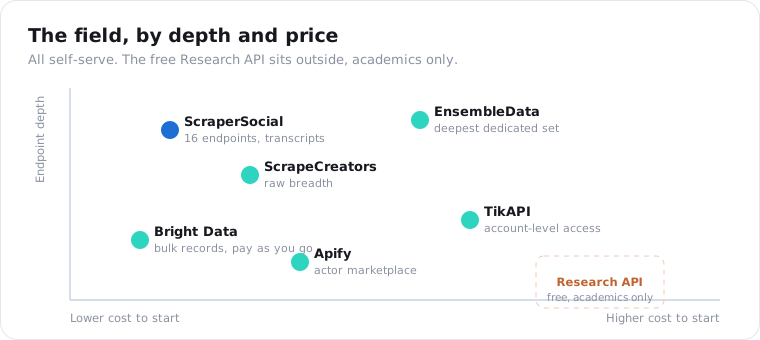
The six that most teams shortlist, ranked by how much TikTok they cover without an academic gate. All read public TikTok data and return JSON; they differ on depth, schema, and how they bill. I have named the real trade on each rather than the marketing line.
- ScraperSocial. Sixteen live TikTok endpoints in a normalized API covering 30+ platforms, including video transcripts and AI summaries, from $5/mo. Best when you want TikTok data with processing in the same schema as your other sources.
- EnsembleData. A dedicated social-data API with one of the deepest TikTok endpoint sets, from $100/mo on daily units that expire each day. Best for steady, high-volume TikTok-only pipelines.
- ScrapeCreators. Pay-as-you-go with credits that never expire and 22 TikTok routes, $47 for 25,000 credits. Best for raw TikTok breadth across many platforms.
- Bright Data. Enterprise proxy infrastructure and TikTok datasets around $1.50 per 1,000 records, 5,000 free a month. Best for bulk delivery at real scale.
- Apify. A marketplace of TikTok actors billed around $1.70 per 1,000 results plus platform and proxy fees. Best for custom or scheduled scraping jobs.
- TikAPI. The one option offering OAuth account-level access, from $29/mo for 300 requests a day. Best when you need authenticated, account-scoped calls.
The category runs wider than six. SocialCrawl, SociaVault, Oxylabs, ScrapingDog, and SocialKit all sell TikTok data too. The six above are the ones I see teams shortlist once they accept the official API is not an option.
Which TikTok API has the deepest coverage and transcripts?
The dedicated TikTok APIs go deepest, and only a few return transcripts. EnsembleData, ScrapeCreators, and ScraperSocial carry the widest TikTok endpoint sets, reaching past profiles and videos into comments, followers, sounds, and search. Transcripts are rarer: ScraperSocial and ScrapeCreators return the spoken words from a video, while most scrapers stop at metadata. If transcripts or summaries drive your pipeline, confirm them before you commit.
Depth is where TikTok tools separate.
A basic scraper returns a profile and its recent videos. A deep one reaches the building blocks of monitoring and discovery: a creator’s follower and following lists, their top videos, the videos under a given sound, hashtag and keyword search, and every comment on a video. Those endpoints are what a real product is built from, and the thin tools do not have them.
Transcripts are the sharper divider. TikTok is video, so the spoken words are often the actual content, and pulling them turns a video into searchable, summarizable text. ScraperSocial exposes this through its TikTok transcript endpoint and pairs it with an AI summary endpoint, so a video becomes text and then a summary in two calls. For an LLM pipeline, that removes a whole transcription stage.
What can you build with TikTok data?
Mostly trend, creator, and competitor intelligence, at a scale you cannot match by watching the app. Teams pull TikTok data to catch breakout videos and rising sounds early, to vet influencers by real audience and engagement rather than follower count, and to track what competitors and their creators are posting. The data is public videos, stats, comments, and sounds, so the products are about what is happening on the platform, not private accounts.
Trend monitoring is the most common build.
A scheduled hashtag or sound search surfaces videos as they climb, so a brand catches a rising format while it is still rising instead of a week after it peaks. The play counts and post times are the signal, and pulling them on a loop turns a feeling about what is trending into a ranked list.
Influencer vetting is the next one. Before a brand pays a creator, it pulls that creator’s recent videos and their real view and engagement numbers, so it screens for audience quality and brand safety instead of trusting a follower count that can be bought. The transcript endpoint helps here too, because it lets a team read what a creator actually says, beyond the raw view numbers.
Competitor tracking rounds it out. Pulling a rival’s videos, their engagement, and the sounds and hashtags they use shows their content strategy from the outside, updated as often as you schedule the pull.
How much do TikTok data APIs cost in 2026?
If you’re building something commercial on TikTok data, ScraperSocial has the lowest paid monthly plan on this list at $5, with 25 free credits and no contract. EnsembleData’s paid tier is $100 a month, TikAPI starts at $29, and Apify’s Starter plan is $19. The same plan covers transcripts and AI summaries, which most TikTok scrapers stop short of.
| Provider | How you pay | To start | Access and setup |
|---|---|---|---|
| TikTok Research API | Free, 1,000 requests/day | Academic application and ethics review | Academics only |
| ScraperSocial | Credits per item: 1 per comment, 1-2 per video, 2 per transcript | 25 free credits, then $5/mo (1,000 credits) | Self-serve; one key, failed calls not billed |
| ScrapeCreators | Credit packs that don’t expire | $47 for 25,000 credits | Self-serve |
| Bright Data | Per record, about $1.50 per 1,000 | 5,000 records free each month | Self-serve |
| Apify | About $1.70 / 1,000 results plus platform and proxy fees | Free plan; Starter $19/mo | Self-serve; you pick and run an actor |
| EnsembleData | Daily units that expire each day | 50 units/day free; $100/mo paid | Self-serve |
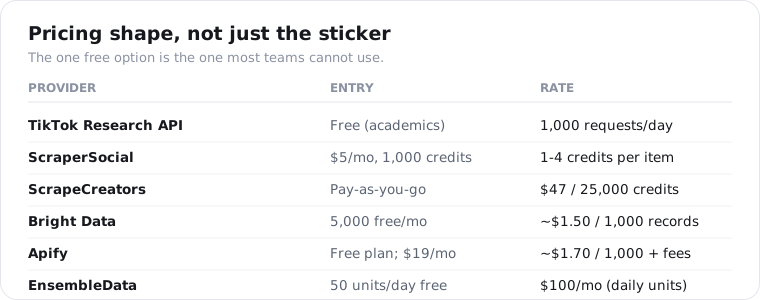
Watch the billing unit, not the headline. EnsembleData’s daily units expire at the end of each day, so a spiky workload wastes what it does not use. With per-item credits you pay for the videos that come back, and a blocked or failed request costs nothing.
Put a number on a real trend job. Pulling 50 videos for each of 10 hashtags is 500 videos at 1 credit, so 500 credits or $2.50, and transcribing the 20 best performers adds 40 credits, 20 cents more. A raw per-record rate also leaves out the work of normalizing what comes back, which you skip when every endpoint answers in the same envelope.
If you expect to pull millions of TikTok records a month, price a bulk record vendor alongside this.
The free Research API is not really a price option for most readers. It costs no money and a great deal of eligibility, and a for-profit team does not qualify at any budget.
Does the TikTok US divestiture change API access?
Not directly, at least not yet. The US divestiture closed in January 2026, moving TikTok’s American operations into a new entity called TikTok USDS, majority-owned by a US investor group with ByteDance holding a minority stake. The official API products and their restrictions have not changed as a result, and the third-party data APIs that read public pages kept working through the transition. The ownership change is worth watching, not acting on.
Every TikTok data buyer is asking this in 2026.
The honest answer is that the deal reshaped ownership, not the developer surface. The Research API is still academics-only, there is still no self-serve commercial API, and public pages still render the same data to a logged-out visitor. Nothing about how you get TikTok data changed on the day the deal closed.
What it does add is a reason to avoid single points of failure. If your pipeline depends on one access method and the politics shift again, a provider that reads public pages across many platforms is a softer landing than one tied to a single official program that could change under new owners.
What should you check before you pick a TikTok API?
Three things the comparison tables skip: data freshness, endpoint coverage for your exact job, and how the provider handles TikTok’s blocking. TikTok is video and fast-moving, so a stale or shallow source fails quietly. These decide whether the data is usable, and the per-1,000 rate does not.
Freshness first, because TikTok trends move in hours. The official Research API lags up to 48 hours to index a new video and up to 10 days on some stats, which is fatal for trend work. Third-party APIs that read the live page are current, but confirm it, because a cached source hands you numbers that were true yesterday.
Then coverage for your specific job. “TikTok data” might mean a creator’s stats, or it might mean every video under a sound. Match the endpoint list to what you actually need before you sign up, because a tool that covers profiles but not sound-videos is useless for music-trend work.
Last, blocking. TikTok fights automated access, so some requests fail, and how a provider absorbs that matters. A managed API that maintains its own residential infrastructure and only bills on returned results protects you from paying for blocks; a thin wrapper over a fragile scraper does not.
How do you pull TikTok data with one API?
You send a request to an endpoint and get structured TikTok data back, with no academic application and no scraper to maintain. The API reads public TikTok pages on its own infrastructure and bills per item returned, so profiles, videos, comments, transcripts, and search all come through one key and one schema. On ScraperSocial, a hashtag search is one call.
import requests
r = requests.get(    "https://api.scrapersocial.com/v1/tiktok/hashtag-search",    params={"query": "coffeetok", "limit": 25},    headers={"Authorization": "Bearer sk_live_..."},)for v in r.json()["data"]:    print(v["url"], v["views"], v["likes"])
Hashtag in, videos out. No application, no ethics review, no proxy pool.
Each video comes back flat and ready to analyze: the url and caption, the views, likes, comments, shares, and saves counts, the duration_sec and posted_at, the author handle and name, the music name, and the hashtags. That is the full engagement picture plus the sound and the tags, which is what a trend or creator query actually needs, in one object with no second call.
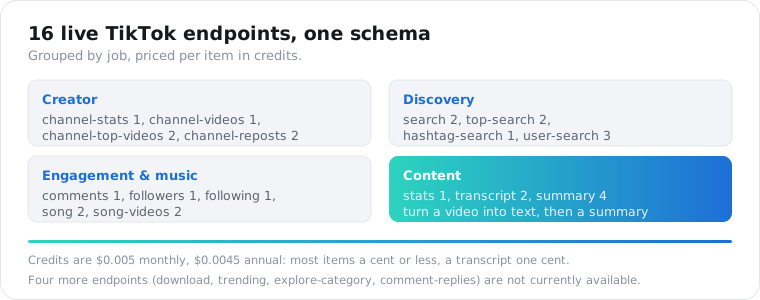
The 16 live TikTok endpoints group into what products actually pull: creator data with channel-stats and channel-videos, engagement with comments, discovery with search and hashtag search, and content with the transcript and summary endpoints.
One mechanic matters for trend work. The search endpoints return a page up to your limit and are built to be polled on a schedule, not walked to the end of a category in one run. A trend loop pulls a hashtag or a sound every hour, diffs the results against what it already stored, and treats the new-and-climbing videos as the signal. That cadence is where TikTok data earns its keep, because the platform moves faster than a once-a-day pull can see, and a scheduled search catches a format while it is rising instead of after it has peaked.
Credits are $0.005 each monthly and $0.0045 annual, so most TikTok items cost half a cent to a cent, and a transcript is one cent. The 25 free signup credits cover a small test across a few endpoints before you add a card.
Which TikTok data API should you pick?
Start with what you are building, because the official API is out for all of it unless you are an academic. If you want TikTok data in one schema with transcripts and summaries, ScraperSocial covers the most jobs from one key. For the deepest dedicated TikTok set at steady volume, EnsembleData; for raw breadth, ScrapeCreators; for enterprise bulk, Bright Data; for account-level calls, TikAPI. Name your job first, and the six-way choice narrows to one or two. Then test before you commit: every provider here has a free tier or trial, so run your actual job through two of them and compare the JSON, not the pricing page.
Frequently asked questions
What is the best TikTok data API in 2026?
There is no single best one, because TikTok has no official commercial API and the third-party options trade coverage against price. For TikTok data in one schema with transcripts and AI summaries built in, ScraperSocial covers 16 live endpoints from $5 a month. EnsembleData and ScrapeCreators have the deepest dedicated TikTok sets, while Bright Data and Apify are built around bulk record delivery and scraping jobs you configure. Choose based on whether you want one schema with processing, raw depth, or to run scrapers yourself.
Is the TikTok API free?
Not for commercial use. TikTok’s only free API is the Research API, and it is restricted to non-profit academic researchers in approved regions after an application and ethics review. The Commercial Content API covers ad transparency, not general data, and the Display API only reads your own account. Any developer building a product uses a paid third-party data API, because TikTok publishes no free self-serve API for public data.
Can I use the TikTok Research API for a commercial project?
No. TikTok’s Research API terms explicitly exclude commercial use, and creators, advertisers, and for-profit companies are ineligible. Platforms caught using research credentials commercially risk losing access. If you are building anything that makes money, the Research API is off the table by rule, and a commercial third-party data API that reads public TikTok data is the compliant route instead.
How much does TikTok data cost?
Starting costs little. ScraperSocial’s entry plan is $5 a month, cancel anytime, plus 25 free credits, against $100 a month for EnsembleData’s paid tier, $29 for TikAPI, and $19 for Apify’s Starter plan. Credits are published per endpoint: a hashtag-search video is 1, a comment 1, a transcript 2. A 500-video trend check is 500 credits, $2.50, and failed calls are never billed.
Which TikTok API has video transcripts?
A few. TikTok’s Research API exposes a voice_to_text field, and among third-party APIs, ScraperSocial and ScrapeCreators return transcripts for public videos. ScraperSocial’s transcript endpoint pulls the spoken words from any public TikTok video URL and its summary endpoint returns an AI summary, which most TikTok scrapers that stop at metadata do not offer. If transcripts drive your pipeline, check for them explicitly, because coverage varies.
Does the TikTok US divestiture affect API access?
Not directly, so far. The US divestiture closed in January 2026, moving TikTok’s American operations into a new entity, TikTok USDS, majority-owned by a US investor group with ByteDance holding a minority stake. The official API products and their restrictions have not changed as a result, and third-party data APIs that read public pages keep working. The ownership change is worth watching, but it has not reshaped data access in 2026.
Skip the academic gate
You do not have to qualify for anything to start. Send a hashtag to the TikTok search endpoint or a creator to channel-stats, and read the JSON back before you build. A key comes from the quickstart in a minute, the pricing page has the per-item credit math, and 25 free credits cover a small pull across a few endpoints. For the two-tool background on why the official route is closed to you, the Research API vs data API guide has the detail.