By Nikhil Kumar. Last updated August 2026.
Apify is genuinely good. That is why “Apify alternatives” is a strange search to type.
The best Apify alternative for social media data is a purpose-built social API when you only need social data, and Apify itself when you need custom or non-social scraping. Apify is a marketplace of prebuilt actors you assemble and run; a social API is one endpoint shape across many platforms. If your job is TikTok, Instagram, LinkedIn, and a few more, one social API is cheaper and simpler. If your job is arbitrary sites, keep Apify.
Why do people look for an Apify alternative?
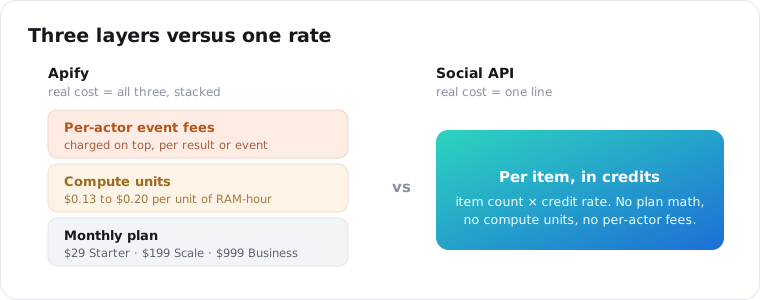
Cost and glue. Apify’s paid plans start at $29 a month for Starter, $199 for Scale, and $999 for Business, and that subscription only buys compute units. Actor per-event fees come on top, and unused monthly credits expire rather than roll over. For social data across a few platforms, you are paying a platform fee plus per-actor fees plus the time to wire separate actors together.
The complaint that comes up most, though, is unpredictable billing. Because you pay for compute time, a misconfigured actor or a site that triggers heavy proxy use can spike a bill with no warning, and premium store actors stack their own per-result fees on top. A store actor charging $4 per 1,000 results can burn through a $29 plan in an afternoon.
The other reason is maintenance. Each actor is its own input schema, its own output shape, and its own failure mode. Stitch five together for five platforms and you own five integrations, not one.
None of this means Apify is bad. It means a general platform charges general-platform prices, and social data is a narrow enough job to buy pre-solved.
When should you keep Apify instead?
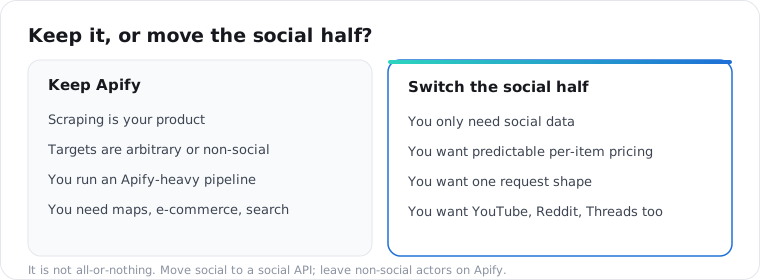
Keep Apify when scraping is your product or your targets are arbitrary. Apify’s store hosts more than 24,000 public actors, and the platform runs anything you can script, on scheduled infrastructure, with proxies and storage built in. No social API matches that range, because no social API is trying to.
Already running an Apify-heavy pipeline? Leave it. Ripping out working infrastructure to shave a few dollars a month is rarely worth the risk of breaking something that ships.
And if half your job is non-social, maps, e-commerce, plain old websites, Apify is simply the right tool for that half. A social API has nothing to offer you there.
So I would not rip Apify out to save money on a mixed workload. I would move the social half to a social API and leave everything else exactly where it works.
What are the best Apify alternatives, and who is each for?
Match the tool to the job, not to a leaderboard. Here are the alternatives that actually differ from each other, and the one thing each is best at.
- ScraperSocial. One social API across 33 platforms with the same request shape, per-item credit pricing, and a $5 entry point. Best when you want social data without assembling or maintaining scrapers.
- Bright Data. Proxy-backed data infrastructure with a 400M-plus residential IP network and a pay-per-record social scraper around $1.50 per 1,000 records. In an independent 75,000-request benchmark across five social platforms, it posted an 88% success rate. Best for enterprise scale and heavily blocked targets.
- PhantomBuster. A no-code automation tool built around LinkedIn lead generation. Best when you want visual workflows, not code.
- Octoparse. A desktop point-and-click scraper with hundreds of prebuilt templates. Best for analysts who do not write code and want a visual builder.
- ScrapingBee and ScraperAPI. General-purpose scraping APIs that handle proxies and headless browsers. Best when social is one small piece of a larger scraping project.
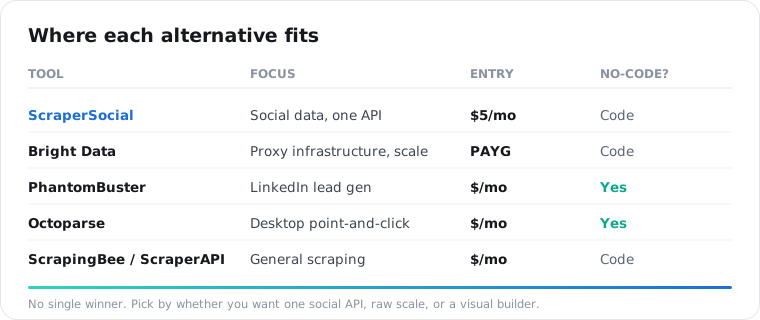
If your job is “get social data from a handful of platforms without babysitting scrapers,” the first row is the fit. If it is “collect anything at massive scale,” it is Bright Data. If it is “no code,” it is PhantomBuster or Octoparse.
What do you look for in an Apify alternative?
Look for a consistent response shape, predictable pricing, and coverage of the platforms you actually need. Those three decide whether you integrate once or forever. A tool that returns a different JSON shape per platform recreates the exact maintenance you were trying to escape.
The signals worth checking before you commit:
- One request shape across platforms, so a comments call looks the same everywhere.
- Per-item pricing you can model, not a platform fee plus compute units plus per-actor fees.
- Real coverage of your target platforms, including the newer ones like YouTube, Reddit, and Threads.
- Transcripts and an MCP server if you are feeding an AI agent, since raw scraping tools rarely include either.
Apify scores well on range and poorly on the first two for social work. That is the whole trade.
Apify vs a purpose-built social API: the cost comparison
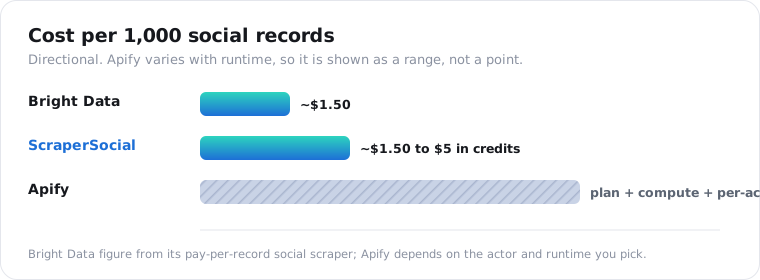
A social API is usually cheaper for social data because there is no platform fee and no compute-unit math. With Apify you pay the subscription, then compute units at $0.13 to $0.20 per unit, then per-actor event fees, and you estimate runtime to predict a bill. With a per-item social API you pay a few cents per record and the invoice is the item count times a credit rate.
Here is the honest version in a table. Apify’s real cost varies with runtime, so treat its per-1,000 figure as directional, not fixed.
| Apify | ScraperSocial | Bright Data | |
|---|---|---|---|
| Entry price | $29/mo (Starter) | $5/mo (1,000 credits) | Pay-as-you-go |
| Model | Plan + compute units + per-actor fees | Per item, in credits | Per record delivered |
| Social record cost | Varies with runtime | ~1-10 credits (¢ each) | ~$1.50 per 1,000 |
| Coverage | 24,000+ actors, any site | 33 social platforms | Major social + any site via proxies |
| Setup | Assemble and run actors | One GET request | Proxy + scraper config |
| Best for | Custom, mixed scraping | Social data, one API | Enterprise scale |
One more Apify detail worth knowing: the platform is retiring its rental actor model, moving everything to pay-per-event billing through 2026. If your cost model was built around a rental actor, it is changing regardless of what you do.
How do you migrate from Apify actors to one API?
Swap each actor call for the matching endpoint, and delete the glue. Where you ran a TikTok actor, an Instagram actor, and a LinkedIn actor as three separate jobs with three output shapes, you now call three endpoints that return the same envelope. The normalization code you wrote to reconcile actor outputs goes away.
The first time I did this, the API was not the surprising part. Watching a whole file of per-actor field-mapping hacks collapse into three identical lines was.
The move is usually smaller than it looks:
# Before: one Apify actor run per platform, each with its own input + output shape# After: the same request shape on every platformimport requestsBASE = "https://api.scrapersocial.com/v1"H = {"Authorization": "Bearer sk_live_..."}
for platform in ["tiktok", "instagram", "linkedin"]:    r = requests.get(f"{BASE}/{platform}/comments",                     params={"url": post_url, "limit": 50}, headers=H)    store(r.json()["data"])
Start with your highest-volume social actor, move that one endpoint, and compare a week of bills. If the per-item math wins, move the rest. Keep the non-social actors on Apify, because that is still the right tool for them.
The short version
Apify is the right tool for custom and non-social scraping, and the wrong tool for a clean social feed. If you only need social data, a purpose-built API across 33 platforms costs less and integrates once. If you need anything else, Apify earns its price.
Frequently asked questions
Is there a cheaper alternative to Apify for social media data?
Yes. Apify’s paid tiers start at $29 a month plus compute units and per-actor fees, while purpose-built social APIs start around $5 a month with per-item pricing. For social data specifically, a single social API is usually cheaper and simpler than assembling and running Apify actors, because you skip the platform fee and the per-actor compute.
What is the best Apify alternative for social media data?
It depends on the job. For a clean multi-platform social API at a low entry price, a purpose-built social data API like ScraperSocial fits best. For enterprise-scale proxy-backed collection, Bright Data. For no-code LinkedIn lead gen, PhantomBuster. Match the tool to whether you want one API, raw scale, or a visual builder.
Apify vs Bright Data: which is better?
Apify is a marketplace of 24,000-plus prebuilt actors you assemble and run yourself; Bright Data is proxy-backed data infrastructure with a pay-per-record social scraper around $1.50 per 1,000 records. Apify suits custom, mixed scraping; Bright Data suits high-volume, blocked-heavy targets. Neither is a single clean social API out of the box.
Is Apify worth it?
For general and custom web scraping, yes. Apify’s store has tens of thousands of actors and it runs anything you can script. It gets expensive and fiddly when you only need social data across a few platforms, because you pay a platform fee, compute units, and per-actor fees, and you maintain the glue between actors yourself.
Can I replace multiple Apify actors with one API?
For social data, usually yes. A purpose-built social API exposes one request shape across many platforms, so a stats call, a comments call, and a search call look the same on TikTok, Instagram, LinkedIn, and the rest. That replaces a rack of separate Apify actors with a single integration you never re-wire.
Does Apify have a free plan?
Yes. Apify’s free plan includes about $5 of monthly platform usage, and unused credits expire at the end of each cycle rather than rolling over. It is enough to test an actor, not to run production social collection, which is where the paid tiers and per-actor fees start to add up.
Try the social half
Run one platform through a social API before you decide anything. The comparison of social data APIs lays out the options, and 100 free credits are enough to move your highest-volume social actor and check a real bill against Apify’s.