By Nikhil Kumar. Last updated October 2026.
Short video is where a lot of public conversation happens now, and most of it is spoken, not written.
Social video transcripts turn that speech into text you can sample, code and quote. For research, treat them as a record of what was said in public videos, collected with a written method: a sampling frame you can defend, a count of videos with no captions, an accuracy check against the audio, and protection for the people in the data. This guide covers each step for TikTok and YouTube.
Can you use TikTok and YouTube transcripts for research?
Yes, as data on what people said in public videos, provided you document how you got them. Transcripts suit discourse analysis, claim tracking, framing studies and market research. They don’t capture images, on-screen text, tone or editing. The bigger risks are in sampling and missing captions, not the transcripts themselves, so most of a good method section is about those two.
The scale makes video worth studying. A 2026 paper in the Journal of Quantitative Description that sampled one full hour of TikTok estimated 269 million posts on a single day. No team reads that, so every study is a sample, and the sample is where bias creeps in.
The same paper is a useful reality check on what “TikTok” looks like. In that hour, 51.9% of posts received zero comments, and mean views sat around 2,500. Search results and trending pages show you a very different, far more popular slice.
What can social video transcripts tell you, and what can’t they?
They tell you what was spoken: claims, arguments, phrases, recurring narratives, the words creators use about a topic. They can’t tell you what was shown, written on screen or implied by tone, music or editing. On TikTok in particular, a lot of meaning lives in visuals and captions typed over the video, so a transcript-only study answers a narrower question than a full video study.
Be precise about what your text is. The transcripts in this guide come from the caption tracks platforms publish, often auto-generated, not from human transcription.
They also differ by platform. YouTube transcripts come with timestamped segments, so a quote can point to the second it was spoken. TikTok transcripts arrive as one block of text with segments set to null, which means a quote points to the whole video.
This post explains why TikTok has no timestamps.
If your question depends on visuals, pair transcripts with a manual coding pass on a subsample of videos. Code what is shown, what is written on screen and what is said as separate variables, so a reader can see which findings rest on speech alone.
How do you build a sample you can defend?
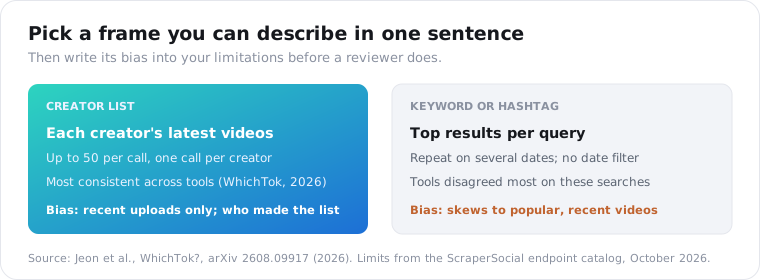
Pick a sampling frame you can describe in one sentence, such as all videos from a list of 40 creators, or the top 50 results for five keywords on five dates, and log every query with its date. Platform search ranks by relevance and engagement, so a keyword sample skews toward popular videos. Say that plainly in your limitations, rather than calling it random.
Tool choice matters more than most method sections admit. The WhichTok study, accepted at ICWSM 2027, compared the TikTok Research API with two other collection tools and found “substantial cross-tool differences, especially for hashtag and keyword searches.” Only the user endpoint gave consistent results across tools.
That has a practical consequence. Creator-based samples are more stable than keyword samples, so if your question allows it, build the frame from a creator list and pull each creator’s recent videos.
Two frames work well with a data API:
| Frame | How to collect | Main bias to report |
|---|---|---|
| Creator list | Each creator’s latest videos, up to 50 per call | Only recent uploads; who made your list |
| Keyword or hashtag | Top results per query, repeated on several dates | Skews to popular, recent videos |
The TikTok search endpoint has no date filter and returns at most 50 results per call, so repeat queries on a schedule to build a time series instead of trying to pull a year in one go.
The TikTok Research API is the other route. It’s free for approved academic researchers, based in the US or Europe, with a quota of 1,000 requests a day of up to 100 records each, per the WhichTok authors. The Research API comparison covers when each one fits.
How do caption gaps bias a transcript dataset?
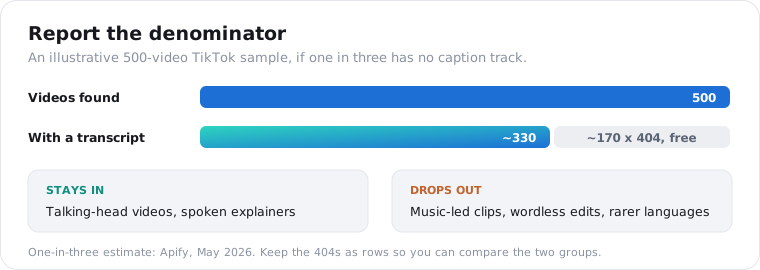
Videos without captions drop out of a transcript dataset, and they don’t drop out at random. Music-led clips, wordless edits and videos in less-supported languages tend to be the ones without captions, so a transcript corpus over-represents talking-head content. Always report two numbers: videos found and videos with a transcript, and describe what kinds of video went missing.
The gap is large on TikTok. Apify’s content team estimated in a May 2026 analysis that around one TikTok in three has no text track at all. Check YouTube too; its gap is usually smaller, but it is not zero.
With a caption-based transcript endpoint, those videos return 404 not_found instead of guessed text. For research that’s the outcome you want: you know exactly which videos had a real caption track.
Log the 404s as rows in your dataset, not as errors to discard. A follow-up question like “do caption-less videos differ in engagement?” is answerable only if you kept them.
If speech in caption-less videos matters to your question, you need audio transcription on rights-cleared media. That’s a separate pipeline with its own accuracy profile, so don’t mix the two sources silently.
How accurate are auto-generated captions?
Accurate enough to search, count and code themes, not accurate enough to quote unchecked. Auto captions misspell names and brands, drop words in fast speech and struggle with music, accents and overlapping voices. Published error rates vary widely by audio quality, so measure your own: listen to a random sample of your videos against their transcripts and record the error types you find.
The research on this is thinner than you’d hope, and much of it comes from companies that sell captioning. One older academic study of course videos, published in 2016 in the Journal of Open, Flexible and Distance Learning, found 7.7 phrase-level errors per minute in auto-generated YouTube captions. Models have improved since, which is why your own check matters more than an old benchmark.
A practical accuracy check takes an afternoon:
- Pick 20 videos at random from your sample.
- Listen to each against its transcript and mark substitutions, omissions and garbled names.
- Write the error types into your codebook, so coders know which terms to treat with care.
- Before publishing, verify every direct quote against the audio.
For coding, small errors rarely change a theme. For quotes and claims attributed to a named person, a single wrong word can.
How do you collect transcripts in a reproducible way?
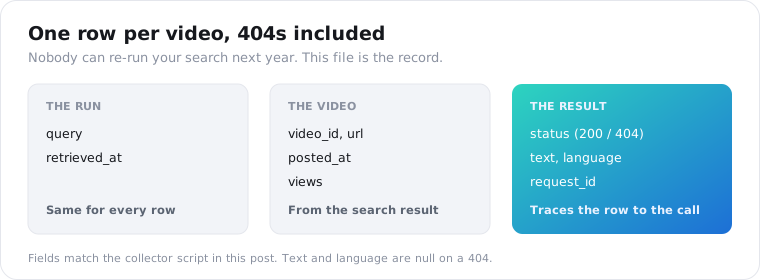
Store the raw response for every call, along with the query, the retrieval time and the response’s request_id, including calls that failed. Platforms change, videos get deleted and ranking moves daily, so nobody can re-run your search next year and get the same results. Your stored raw data and your collection log are the reproducible record.
Here’s a minimal collector in Python that keeps every row, 404s included:
import datetime, json, requests
BASE = "https://api.scrapersocial.com/v1/tiktok"H = {"Authorization": "Bearer sk_live_..."}run = {"query": "standing desk", "retrieved_at": datetime.datetime.now(datetime.timezone.utc).isoformat()}
hits = requests.get(f"{BASE}/search", params={"query": run["query"], "limit": 50},                    headers=H, timeout=60).json()["data"]
with open("corpus.jsonl", "w", encoding="utf-8") as out:    for v in hits:        r = requests.get(f"{BASE}/transcript", params={"url": v["url"]}, headers=H, timeout=60)        body = r.json()        ok = r.status_code == 200        out.write(json.dumps({            **run, "video_id": v["id"], "url": v["url"], "posted_at": v["posted_at"],            "views": v["views"], "status": r.status_code,            "text": body["data"]["text"] if ok else None,            "language": body["data"]["language"] if ok else None,            "request_id": body.get("request_id") or body.get("error", {}).get("request_id"),        }) + "\n")
Every line in corpus.jsonl is one video with its status, so your caption-gap count is a one-line query later. The request_id lets you trace any row back to the exact call. The rate-limit docs cover pacing if you collect across many queries.
In your method section, name the tool and the collection dates. Given how much tools differ, “collected via [tool] between [dates]” belongs in the main text, where reviewers will look for it.
How do you code and analyze video transcripts?
Treat transcripts like any qualitative text: build a codebook from a pilot subsample, have two coders apply it independently, measure agreement, and resolve disagreements before coding the rest. Comments under the same videos add a second layer, how viewers received the claim, which is often the more interesting finding. Language models can speed up first-pass tagging, but a human should check every code that ends up in a result.
A workable split is to open-code a pilot set of around 10% of your sample, settle the codebook, then apply it to the rest. Have both coders double-code a share of the full set too, and report your agreement statistic, such as Cohen’s kappa, alongside the codebook.
Comments are cheap to add. Comments cost 1 credit each on both TikTok and YouTube, and each call returns up to 50. TikTok returns the comments it ranks as most prominent, not the newest, which is another sampling decision to note.
Keep the unit of analysis clear. If you code transcripts per video and comments per comment, report results at each level separately. Say how many comments you pulled per video too, since a fixed cap of 50 gives a small video and a viral one the same weight.
If you use a model to pre-code, give it your codebook verbatim, ask it to quote the transcript text that supports each code, and check those quotes against the source. The research agent guide shows a source-checking step you can reuse.
What do ethics boards and GDPR expect?
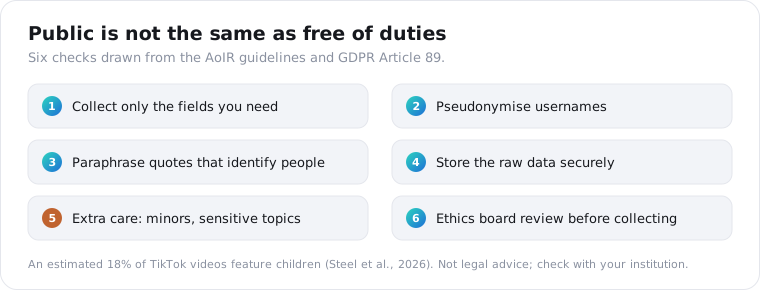
Public posts usually don’t need individual consent, but ethics guidance still asks you to minimise harm, and data protection law still applies. Collect only the fields your question needs, pseudonymise usernames, store data securely, and paraphrase quotes that could identify someone through search. Expect more scrutiny for sensitive topics, minors and marginalised groups, and get your ethics board’s view before collecting.
The AoIR guidelines, which many internet researchers and ethics boards work from, put it simply: “A primary ethical imperative is to avoid harm.” They also tie the level of care to vulnerability: the more vulnerable the people involved, the greater your obligation to protect them.
That matters on TikTok. The same one-hour study estimated that 18% of TikTok videos feature children, so a broad sample will almost certainly include minors.
In the EU and UK, GDPR Article 89 allows research processing subject to “appropriate safeguards,” naming data minimisation and pseudonymisation. If your question can be answered without identifying anyone, the article says it should be.
A data API reads public posts only, so private and followers-only content never enters your dataset. That keeps the collection on the public side of the line most ethics frameworks draw, though it doesn’t remove the duties above.
What does a transcript dataset cost to collect?
Not much at this scale. A 500-video TikTok keyword sample costs about 1,000 credits to find and up to 1,000 to transcribe, roughly $10 at most on the $5 monthly plan, and videos without captions cost nothing. YouTube transcripts cost more per video. Comments are the line that grows fastest, so cap them per video.
| Dataset | Math | Credits | Cost |
|---|---|---|---|
| 500 TikTok search results | 500 x 2 | 1,000 | $5 |
| Their transcripts | up to 500 x 2 | up to 1,000 | up to $5 |
| 500 YouTube search results + transcripts | 500 x 1 + 500 x 5 | 3,000 | $15 |
| 50 comments on each of 100 TikToks | 5,000 x 1 | 5,000 | $25 |
Costs use $0.005 per credit on the monthly plan. If a third of the TikToks lack captions, the transcript line drops to about $3.33, since those 404s are free. Per-endpoint fields and limits are on the TikTok transcript endpoint page.
Sign up through the quickstart and the first 25 credits are free. A 20-video TikTok pilot, found and transcribed, costs about 80 credits; the free allowance covers a five-video version of it, enough to test the method before you commit a budget.
What should your method section report?
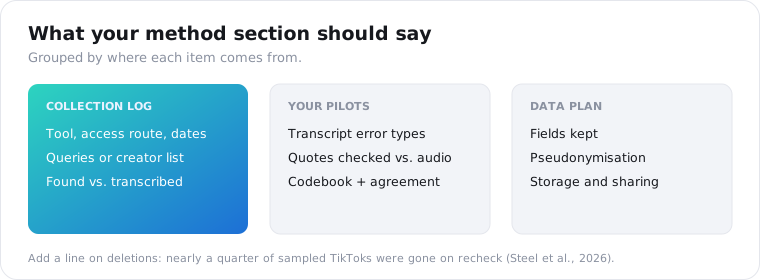
Enough for a reader to judge the sample and for another team to repeat the collection. That means the tool and its version or access route, the collection dates, every query or creator list, the limits per call, the count of videos found against videos transcribed, your accuracy check, your codebook and agreement score, and how you minimised and stored personal data.
Most of these come straight out of the collection log, which is the main reason to keep it from the first call. Writing them up after the fact, from memory, is where studies lose detail.
A short checklist you can paste into a protocol:
| Report | Where it comes from |
|---|---|
| Tool, access route, collection dates | Your collection log |
| Queries or creator list, results per call | Your collection log |
| Videos found vs. videos with a transcript | Count of 200 vs. 404 rows |
| Transcript error types and quote checks | Your 20-video listening sample |
| Codebook and agreement score | Your coding pilot |
| Fields kept, pseudonymisation, storage | Your data management plan |
Deleted videos are worth a line too. The one-hour TikTok study found nearly a quarter of sampled posts were gone when the authors checked back, so a dataset you collect today will not match what a reader can find next year. Say that the raw transcripts are your record, and say whether you can share them under your ethics approval.
Frequently asked questions
Can I use TikTok transcripts in academic research?
Yes, as a record of what was said in public videos, with the method written down. State how you sampled, how many videos had no captions, how you checked accuracy, and how you protected the people in the data. Many ethics boards treat public posts as lower risk, but most still want to see how you minimise and store personal data, so ask yours before collecting.
Do I need the TikTok Research API for academic work?
Not always. The Research API is free for approved academic researchers in the United States and Europe and comes with a daily quota, but approval takes time and excludes most commercial and non-academic teams. A third-party data API works without approval. Either way, a 2026 comparison found different TikTok tools return quite different data for the same query, so report which one you used.
How accurate are auto-generated captions for research?
Good enough to search and code themes, not good enough to quote without checking. Auto captions misspell names, drop words in fast speech and struggle with music and accents, and published error rates vary widely by audio quality. Listen to a random sample of your videos against their transcripts, record the error types, and verify every quote against the audio before it goes in a paper.
How do I cite a TikTok or YouTube transcript?
Cite the video itself in your style guide’s format, with the creator, date, title or caption and URL, then add a note on how you obtained the text, the tool and the retrieval date. If you quote a transcript, say whether it came from auto-generated captions. That note lets a reader judge accuracy and lets another team repeat your collection.
Do I need consent to research public TikTok videos?
Usually not individual consent for public posts, but ethics guidance still expects you to avoid harm. The AoIR guidelines tie your obligations to the vulnerability of the people involved, and a 2026 study estimated 18% of TikTok videos feature children. Pseudonymise usernames, paraphrase identifying quotes, and get your ethics board’s view before you start, especially for sensitive topics.
How much does a transcript dataset cost to collect?
Less than most teams expect. A 500-video TikTok keyword sample costs about 1,000 credits to find and up to 1,000 to transcribe, roughly $10 at most, and videos without captions are free. On YouTube, search costs 1 credit per result and transcripts 5 each. Comments cost 1 credit each on both platforms.
Run a pilot before you write the method section
Pick one query or a short creator list, run the script above with limit set to 20, and count the caption gap and the errors you hear. Those two numbers will shape your sampling plan more than any guide can. Get a free key, run the pilot this week, and write the method section from what you find.